Proof
Snapshot
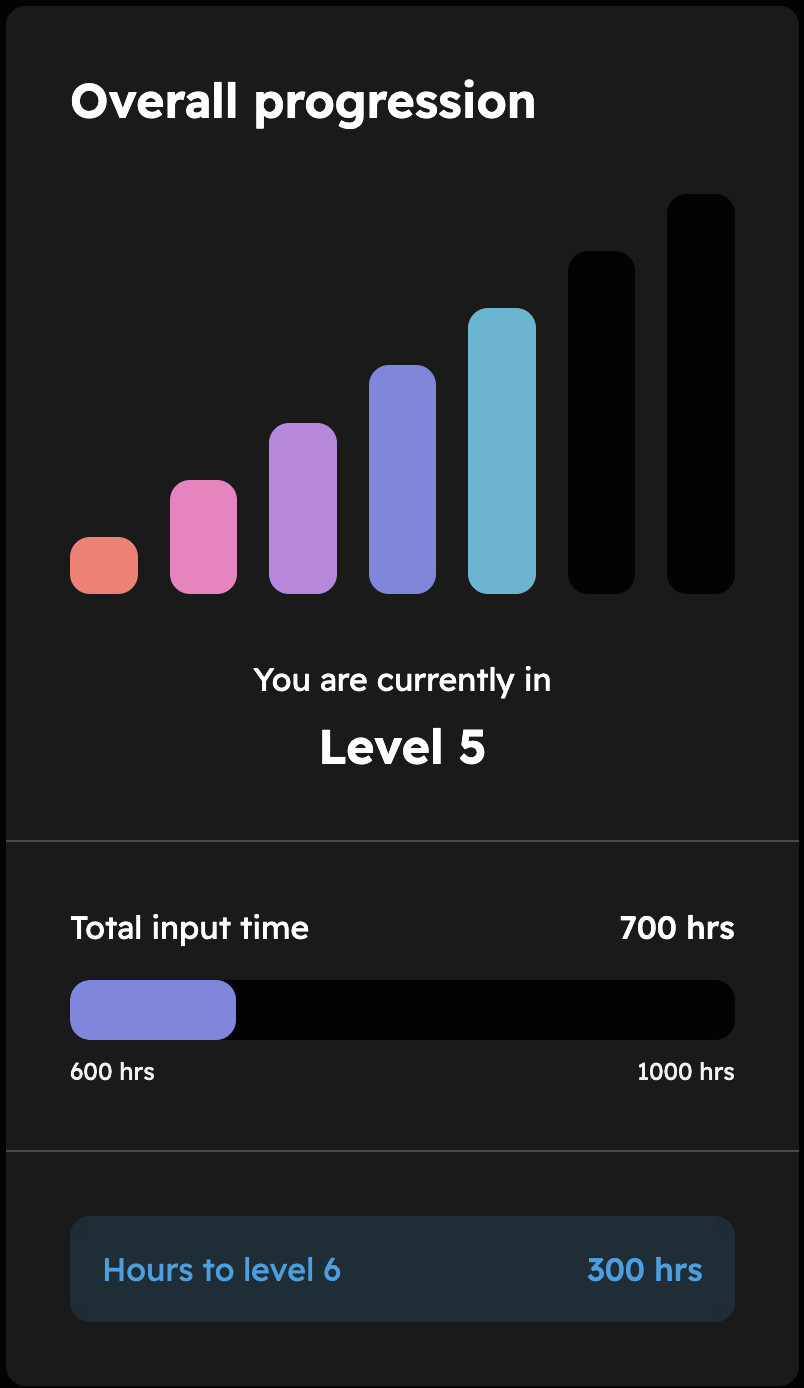
- Listening hours: 700.
- Daily input since 650: ~2.27 hours, or about 2 hours 16 minutes per day. Fifty hours over the 22 days since my 650-hour post on September 25.
- Main input: Dreaming Spanish, alongside a growing variety of general-audience Spanish videos, interviews, and conversations.
- Reading: 19 books finished and approximately 400,000 words read. Finished Cajas de cartón during this stretch.
- Speaking: My first full Spanish-speaking Preply lessons, plus occasional ChatGPT voice conversations.
Seven hundred hours. Wow.
It’s not a major Dreaming Spanish level boundary, but it’s a lot of time that I’ve consistently dedicated to acquiring Spanish.
I started these notes thinking I didn’t have much to report. Apparently I did.
What’s Improved
Returning to the video I couldn’t handle at 400 hours
One of the most satisfying experiences came just before 700.
I tried an older advanced Dreaming Spanish conversation with Andrés and Pablo about using AI for language learning. These are roughly hour-long episodes of two people talking. I remembered attempting this series much earlier and finding it so difficult that I had to turn it off within a few minutes.
This time, I could follow along for the most part. There were vocabulary gaps, but it didn’t feel overwhelming or beyond my capabilities.
Having records turned out to be very useful. In my 400-hour post, I had written:
I watched an advanced Dreaming Spanish discussion about AI and could not make it past five minutes.
The linked episode was their discussion about jobs in the ChatGPT era. So I went back to that exact video, too.
Six minutes in, it was totally accessible. I needed to give it my full attention, but I could follow the conversation just fine. Then I got through more than thirty minutes and realized something even stranger: with focus, it sounded surprisingly slow. I was along for the ride, following their different examples of jobs that might be replaced by AI.
Then I finished the whole thing.
It was a very interesting discussion, and I’d love to hear them revisit it now that a few years have passed. But the contrast with my earlier experience was fantastic. What I couldn’t handle for five minutes at 400 hours was now an hour-long conversation I could follow and enjoy.
I’m a sample size of one. This isn’t proof of every claim anybody makes about Dreaming Spanish. It’s evidence that the input-heavy approach has worked for me and that I’m making genuine progress.
Gaining a new sense
That rewatch gave me a particularly clear comparison, but I’ve been noticing smaller versions of this throughout the stretch.
A Mexican programmer talking about his salary, taxes, and project expenses was fast and challenging, but within reach. Several hundred hours earlier, similar speech could be so far beyond me that I couldn’t even sit through it. Now I could stay with it, even though following it still took intense focus.
I had similar moments watching two Spaniards discussing tips for Spanish learners and an interview with Faustino Oro. With the latter, I definitely needed to stay engaged, but when I did, I could track the conversation. Sometimes I can even catch myself thinking, they’re speaking fast, but I’m getting it, without immediately losing what they’re saying.
I’ve been conceptualizing this as staying in the meaning. More often, I can follow what someone is saying as they say it, staying with the thought as it develops. That ability has been growing a little at a time throughout this process.
The reason it feels powerful isn’t that I’ve suddenly become fluent. It’s that I remember what it felt like when I couldn’t do this.
It feels as though I’m developing another sense. These conversations, ideas, and experiences were always there, but I couldn’t perceive much of what was happening in them. Now I can hear someone explain their work, tell a story, or share an opinion and actually take it in. More of the world is becoming available to me through Spanish.
These aren’t sudden revelations of fluency or native-level understanding. They’re tiny accretions on the way to acquiring this new sense.
Finishing Cajas de cartón
Cajas de cartón was fantastic. Moving, touching, and very real. I really felt for this family.
The chapter about the baby becoming desperately ill was intense. The Christmas chapter made me cry: the mother crying, then receiving a sweet gift that called back to a detail from earlier in the chapter. It was so well done.
The penultimate chapter hit me hard, too. The boy from a wealthy family showing Francisco his fancy coin collection, Francisco’s own pennies, his sister spending them on gumballs. Then the loss of his little notebook, where he’d been collecting grammar, spelling, and math rules. He had memorized so much that losing the notebook didn’t mean it was all lost.
It said so much without even saying it.
The language is pretty straightforward, but there is a lot to the story. You get these snippets of the family’s life, and there’s so much underneath when you stop to think about what that itinerant agricultural life must have been like, with so many children, so much backbreaking (literally) labor, and so much uncertainty.
I could read it smoothly for the most part. There were still unfamiliar words, particularly verbs, but usually I knew what was happening in the scene. I could keep going without looking everything up. Sometimes, after seeing the plot unfold a little more, I could reread a paragraph with unknown vocabulary and understand it better.
That let me stay in the flow and go back to investigate words as needed. It’s been so refreshing to move beyond graded readers into literature like this.
I also learned something fascinating about the book’s bilingual history. The collection appeared first in English as The Circuit, but the title story began in Spanish before Jiménez translated it into English. And Cajas de cartón is his own Spanish translation of the collection.1 That’s much more interesting than a simple English-original, Spanish-translation story.
The ending was devastating. I can see why there’s more to his story. I might return to the later books, just as I might return to Manolito Gafotas, but for now I’m moving on to other reading.
Fifty minutes of español mocho
My crosstalk sessions have been something I genuinely look forward to each week. During one conversation about generative AI, my tutor commented that he could tell I was following him even though he was speaking bastante rápido. He suggested, without pressure, that I might try more Spanish output.
Eventually I decided to spend an entire lesson speaking Spanish.
We started with some weekend chit-chat and a reading passage about Franco that he had selected for the lesson. There were more such passages available, but instead we moved into a conversation about monuments, historical memory in the United States, and the housing crisis in Spain.
It kind of tripped me out that I could spend fifty minutes doing that in Spanish.
Not smoothly. Sometimes getting the words out took a while. I occasionally asked for a translation. At one point I wanted to say una pesadilla and said una pantalla. I recognized the mistake a little after I’d said it.
I jokingly borrowed español mocho from Cajas de cartón to describe how it feels. Speaking is unusual and comes in spurts. It’s not as though Spanish has suddenly started pouring out spontaneously.
A later lesson felt rough, too, but we talked about La sociedad del cansancio, meritocracy, The Tyranny of Merit, toxic positivity, his Camino de Santiago, and a little chess. Around fifteen or twenty minutes in, I looked at the clock and wondered how I was going to keep this going. Then I stopped paying attention to the clock, and suddenly the lesson was over.
I think I made my points well enough. Thankfully, he wasn’t in a rush. It was an enriching and enjoyable conversation, even while speaking itself remained difficult.
What’s Still Hard
Understanding still takes attention
My comprehension isn’t where I want it to be yet. There are still huge gaps, and Spanish requires much more mental energy than English.
In English, meaning can arrive just from hearing something, even in the background. With Spanish, I generally have to focus and stay engaged. Being able to follow a fast conversation doesn’t mean I can follow it while doing three other things.
Acquiring Spanish keeps reminding me how much English I take for granted. I had read about the enormous vocabularies fluent speakers have,2 but I don’t think I really appreciated it. Now I do. It’s easy to underappreciate the vastness of an ability that works without much conscious effort.
My biggest everyday challenge lately is often staying present rather than scrolling or multitasking. And it’s not necessarily because the video is boring. Even when I’m genuinely interested, my thoughts wander to work, worries, or other things I need and want to do that day.
It’s hard sometimes to put a boundary between the different activities I want to consistently have in my life. Walking makes it easier to stay mentally present, but my mind can still wander.
Trying to speak while I’m supposed to be listening
Speaking practice has introduced another distraction.
I’ll be listening to someone and start trying to rephrase their point in Spanish myself, or work out how I would respond if we were having a conversation. Meanwhile, they’re still talking.
I really have to watch that. Constructing my imaginary response can take me away from what the person is actually saying.
This isn’t only a Spanish problem. I want to be a more patient listener generally. I want to stop jumping ahead, assuming I know what’s being said, and preparing my answer before the other person finishes.
Sometimes the storytelling is the problem
I also had a useful reminder from a Marce video about her first time smoking weed in college. I could understand the words but found the story hard to follow: tangents, details that seemed to be missing, and advice or moralizing I wasn’t interested in.
For example, a lot of the setup concerned her mother not wanting her to attend a particular college, but Marce also described her mother as relaxed about these decisions. I couldn’t make those pieces fit from the explanation.
Beyond linguistic comprehension, some people just aren’t easy for me to follow in how they tell stories. I don’t enjoy every English speaker’s storytelling either.
What I’m Doing Now
Still enjoying learner content
I’m exploring more material made for fluent Spanish speakers, but learner content is still a regular part of what I enjoy.
I particularly like interviews between hosts of Spain-focused learning channels. I also still love the occasional Español con Juan video. One was almost thirty minutes and entirely understandable. It’s on the borderline of being too easy, but I still get something out of hearing him. He doesn’t speak painfully slowly; he knows how to phrase and repeat things so they’re understood. I find him hilarious, and his examples are well chosen and illustrative.
As a small calibration point, I watched Lorena’s advanced video about going to the dentist, which was rated 78 when I watched it. I found it pretty easy to follow, without notable gaps. Not great evidence of anything in isolation, but one indication of where my comprehension is currently.
And I still love native speakers explaining colloquialisms in Spanish, usually speakers from Spain in my case. I wouldn’t want that to be all my content, but I enjoy it regularly.
I’m also finding that I mostly want to listen to native Spanish speakers, unless a non-native speaker speaks particularly well. A strongly English-accented speaker in one interview really bothered me. I think part of it is that I want the Spanish I listen to to shape my eventual pronunciation, and I’m wary of picking up those English sounds myself. But it’s also more immediate than that: the accent just sounds off to my ear now, enough to distract me from what he’s saying.
Speaking because I feel like it
I’ve been using ChatGPT voice chat for occasional conversations, with a prompt to guide the practice.3 Along with the Preply sessions, that’s more output than I’ve been doing before.
The voice conversations can be frustratingly shallow, though, and I’ve had them repeatedly make things up (this is with the Standard and Live versions of the model). I tried using correction notes my Preply teacher had provided after a Spanish-speaking lesson as the basis for practice. The voice model kept inventing questions that weren’t in the document. Doing the same thing in text chat worked perfectly. Voice chat is useful for getting me talking, but that experience was frustrating when I wanted to work on the actual corrections from my lesson. Voice chat is a fantastic interface, but I haven’t always found the conversation subjectively satisfying, as is often the case for me with chatbots.
Tengo ganas de hablar español.
I don’t know exactly what the routine will become. I’ve tried speaking here and there throughout this process and have also consciously given myself breaks from it. Right now the urge is stronger, so I’m exploring it.
What I’m trying to do is express things in the simplest, most direct way possible. I sometimes search around too much in English for an eloquent or impressive way to say something. That’s not necessary in a lot of ordinary conversation. It’s something I could stand to do less of in English, too.
I’m still deciding whether to buy more Preply lessons. I like talking to this tutor, and he always has interesting things to say. But I may move on to other practice and save the money. I’d love more regular partners, especially people trying to learn English.
Reading without rushing
Finishing Cajas de cartón brought me to nineteen books and roughly 400,000 Spanish words. That’s a far cry from three million (an arbitrary reading goal I set for myself), but it’s still a large number that I can enjoy from this vantage point.
Reading a little every day has felt enormously beneficial, even when I couldn’t read much. But before picking up Antes de ser libres, I’m reading an English book I’ve been meaning to read for a while.
I’m reminding myself that I don’t need to speed through as much Spanish as possible. It’s going to be part of my life for years. I don’t need to rush, panic, or worry. I’ll get back to it.
After Antes de ser libres, I plan to read Solito. Then I may need a change from migration stories. I’m considering Los peligros de fumar en la cama. By the time I get there, I could be around 750 hours, but I’m not making the books into another deadline.
Notable Moments
Learning something and being able to use it
I shared something about Mexico with a friend that I’d learned from an advanced Andrea video.
What struck me afterward was that I’d obtained genuine information in another language, digested it, and been able to wield it myself.
Another example started with Andrés and Agustina discussing whether we’re a society of complainers. Andrés mentioned La sociedad del cansancio, which sounded interesting. I searched YouTube and found a discussion intended for fluent Spanish speakers.
I could hear the strong Rioplatense accent and the rapid speech, but I could follow it very well. Knowing the subject beforehand helped immensely. It was great to go from learner content into general-audience content and get something useful out of both.
I’ve also enjoyed smaller discoveries, like a seven-minute monologue about finding play in adult life. Being able to enjoy something like that without falling apart from the speed is still exciting.
AI and higher mathematics, in Spanish
One of the coolest videos I’ve encountered so far was a lecture about AI in higher mathematics by Javier Gómez-Serrano, a Spanish mathematician at Brown University, speaking virtually to CIMAT in Mexico.
He spoke in Spanish while using English slides. That was an interesting complication: sometimes I’d start reading the slide and stop listening. He wasn’t just reading the English aloud in translation, either. He was explaining, summarizing, and going further into the material.
He wasn’t speaking especially rapidly, and I could generally follow what he was saying. Of course, I didn’t understand all the mathematics. I was mostly interested in his account of what professional mathematicians are experiencing with AI: that it’s already here, not simply hype, and can be a serious collaborator, with human intuition and critical thinking still important.
Very, very fascinating.
Riddles, wordplay, and Catalan
I loved Sandra’s riddles video and another video explaining Spanish riddles and wordplay. In the latter, I didn’t get most of the answers on my own, except for the garlic riddle, but I could catch the puns once they were explained.
Understanding the words is one thing. Working out what the riddle is doing is another. Hearing that many of them were for children was another reminder of just how much children already know in their native language.
I also enjoyed Pablo and Agustina trying crosstalk with Catalan. Earlier in this process, I would have avoided it because I felt I needed pure Spanish and couldn’t handle another language being mixed in.
Now it doesn’t bother me. There’s plenty of Spanish, and it’s fun to use it to explore another language and ideas I wouldn’t normally seek out.
Los Tigres del Norte
Years ago, I first heard about Los Tigres del Norte while reading El Narco, the nonfiction book about Mexico’s cartels.
This time, I listened to their Tiny Desk concert and could understand the message of the first song: being pushed off native lands, belonging, and being more American than the Anglo-Saxons or gringos.
I got that from listening to him sing. Really powerful.
Learning a social skill mostly by myself
There’s something strange about all this. Ultimately, I want to communicate with other human beings. The reading, music, and culture are fantastic, and I think of them as more asynchronous conversations. But a lot of my actual acquisition happens by myself.
I’m listening to things other people have made, using the tools available to me, rather than having real-time interaction. A chatbot can simulate some of that, but it isn’t equivalent to an engaged human-to-human conversation.
I’ve found it interesting to notice that contrast as I start speaking more. So much solitary time acquiring a language I want to use with other people.
Takeaway
I still really love acquiring Spanish. I look forward to listening every day, and I haven’t lost my hunger for the language.
Starting to speak a little more has made listening even more interesting to me. I feel how much my ability depends on what I’ve been taking in, even though getting the words out is still laborious.
An upcoming family trip to Miami around New Year’s will be particularly exciting. I started Dreaming Spanish in late December 2025 after some of my wife’s Cuban relatives from Miami visited and my Duolingo study didn’t help me understand them at all. By the time of my upcoming visit, I expect to have something like 800 hours behind me. I’m really curious to see what that experience is like.
For now, I actually like that I’m still 300 hours away from 1,000. Given what I’ve acquired already, the possibility of more improvement along the way is motivating and energizing.
These fifty hours haven’t brought some sudden transformation. There are still vocabulary gaps, speaking is clunky, and listening takes attention. But I finished an hour-long conversation I couldn’t handle at 400 hours, read another beautiful book, had conversations in my own imperfect Spanish, and kept finding things I could understand that I remember not being able to understand before.
Tiny accretions on the way to acquiring this new sense.
Seven hundred hours is a lot. And I’m excited to keep going.
-
See Francisco Jiménez’s biography and the bilingual history behind his writing. ↩︎
-
Brysbaert and colleagues (2016) estimate that an average 20-year-old native English speaker recognizes about 42,000 words, counting forms like walk, walks, and walked as one word. That estimate comes from asking people which words they recognize, rather than testing whether they can explain or use each one. So the total can include words that look familiar even when their meanings aren’t clear. The authors suggest that active vocabulary, or the words people can use themselves, is roughly half as large or smaller, about 21,000 words or fewer, but their experiment didn’t measure that directly. ↩︎
-
This is the prompt I use to guide my Spanish conversation practice with ChatGPT:
↩︎Quiero practicar conversación en español contigo.
Mi nivel de comprensión es bastante avanzado, pero todavía estoy desarrollando mi capacidad para expresarme.
Mantén una conversación natural conmigo, como si fuéramos dos amigos.
Habla en español a una velocidad natural y con claridad.
Déjame terminar mis ideas, incluso cuando haga pausas para buscar palabras.
Corrige brevemente mis errores gramaticales más importantes, especialmente los que repita, pero sin interrumpirme constantemente.
Prioriza los errores recurrentes o los que dificulten la comunicación sobre los pequeños fallos aislados.
Si digo algo que suena poco natural, enséñame cómo lo diría normalmente un hablante nativo.
Haz preguntas interesantes que me animen a desarrollar mis respuestas y expresar ideas más complejas.
No conviertas la conversación en una clase ni me felicites constantemente.
Prioriza la comunicación, la naturalidad y la fluidez sobre la perfección.
Cuando terminemos la conversación, hazme un breve resumen de mi desempeño.
Incluye:
-
Lo que hice bien, especialmente cualquier mejora notable en fluidez, vocabulario o expresión.
-
Los errores gramaticales o patrones problemáticos que aparecieron varias veces.
-
Algunas expresiones que dije de forma poco natural y cómo las expresaría normalmente un hablante nativo.
-
Un pequeño número de aspectos concretos que sería útil practicar a continuación.
Conserva esos puntos como base para futuras prácticas.
Cuando te lo pida, crea ejercicios o un quiz centrados específicamente en los errores y dificultades que hayan aparecido en mis conversaciones anteriores.
-
Loading comments…