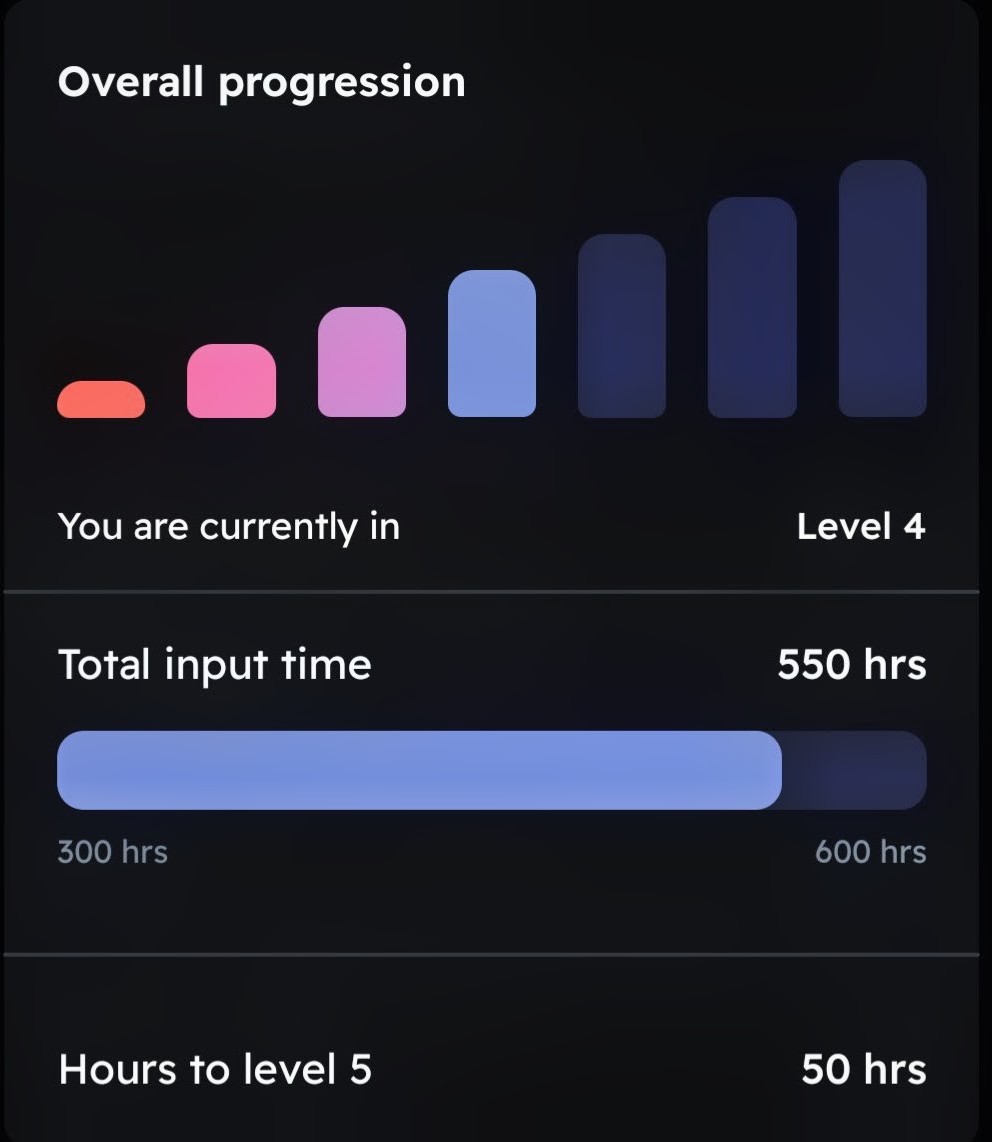
Proof
Snapshot
- Main input: Dreaming Spanish and YouTube
- Daily input: ~2h 30m
- Reading level: B2 graded readers
- Words Read: ~251k (across 14 graded readers)
- Preply placement test: B2.1 / Upper Intermediate
What’s Improved
The changes from 500 to 550 hours have not felt dramatic from day to day. Looking back over my notes, though, there has clearly been progress.
One thing I started noticing around 513 hours was that I was becoming more oriented inside sentences as they were happening. Direct and indirect object pronouns and verb conjugations were starting to register more clearly. Previously, I sometimes felt like I heard a whole sentence and then had to work backward to reconstruct exactly what had happened. Now I am increasingly able to latch onto those little grammatical signals as the sentence unfolds.
It still isn’t perfect, but it feels closer to following Spanish rather than solving Spanish after the fact.
I’ve also noticed that I’m generally not translating Spanish into English in my head. There may be a tiny bit of that happening somewhere, but subjectively it feels much more like Spanish goes directly to meaning. Interestingly, when I’m responding to what I’m hearing, English still wants to come out. Spanish doesn’t yet come comfortably or automatically beyond simple agreements and phrases here and there.
That asymmetry has become much clearer to me: my receptive Spanish is considerably further along than spontaneous output.
Learner content has also become extremely comfortable. Nearing 550 hours, I can increasingly enjoy pretty much anything on Dreaming Spanish. Even advanced videos in the 70s difficulty range, with rapid speech and little or no visual support, are generally comprehensible enough to be useful input.
Advanced Dreaming Spanish still isn’t the same as native content. It is learner content, even when the pacing becomes much more natural. But I’ve reached a point where there is an enormous amount of material available to me that I can simply digest over the next several hundred hours.
Some learner podcasts are now essentially completely comprehensible, around 99%.
Native content is much more variable, but it has also become genuinely usable.
I’ve watched native videos where I was around 80-85% and could follow the person’s overall argument and personality without much trouble. Other native content might be closer to 60-70%, but I can sometimes stay engaged anyway if the topic, visuals, or personalities give me enough context.
At one point I watched a Salvadoran woman living in Sevilla talk about her experience as a foreigner in Spain. I understood enough not just to follow the video but to understand her broader message: Sevilla was vale la pena, but you needed to know what you wanted, have a plan (especially for handling paperwork and bureaucracy), and temper your expectations about things like finding work and housing.
The thought that occurred to me afterward was:
It was just like regular content, except it was in Spanish.
That is probably one of the best summaries of the progress I’ve made.
In my best moments, Spanish was functioning more as a medium than as the object of attention.
What’s Still Hard
There is still an absolutely enormous amount of Spanish I don’t know.
Vocabulary gaps remain obvious. Every time I start feeling good about my level, I encounter another flurry of words I can’t grasp and am rightfully humbled again.
There are also grammatical forms that I can often move past without understanding completely. Hubiese and fuese are two examples. They no longer necessarily stop me from understanding the surrounding sentence, but they still haven’t become fully transparent.
B2 reading has exposed more of these gaps. In Recuerdo by Juan Fernández, I ran into sentences like:
Hacía que aquel momento resultase incluso más sobrecogedor.
I could work through constructions like that, but they revealed grammar I hadn’t completely acquired yet.
Native speech remains enormously inconsistent. One speaker can be very easy. Another can suddenly make Spanish feel opaque again. A speaker who is easy when discussing daily life might become much harder when the topic turns to bureaucracy, specialized vocabulary, humor, or something culturally unfamiliar.
I had a discouraging interaction with a native speaker where she spoke to me in Spanish and I acted as though I understood more than I really did.
Then not long afterward, my father-in-law spoke to me in Spanish and I understood everything he said. In the past, a lot of his speech had sounded mumbly to me so that was a welcome change.
Progress is real, but it is uneven and not always visible.
Humor and expressive native speech also remain difficult. I watched a 40+ minute Argentine/Mexican cooking video where I could enjoy the whole thing but probably only understood 65-70% of the spoken language. There were lots of jokes, vocal inflection changes, and playful delivery.
On the other hand, 65-70% of guys cooking delicious food can be plenty. Comprehension percentages don’t mean much without context.
Learning to Sit With Ambiguity
Something I’ve struggled with throughout this entire process is allowing incomplete understanding to remain incomplete.
I keep chasing the ability to sit with ambiguity.
Subtitles are extremely useful to me because they do at least two things. They help me parse speakers who are difficult to understand acoustically, but they also reduce the burden on short-term memory. Spoken language disappears immediately. Without subtitles, I have to retain the words and phrases someone has just uttered while simultaneously processing whatever comes next and keeping track of the larger context.
Subtitles leave those words sitting there on the screen.
They are useful training wheels, but they are still training wheels. I use them when needed but try to be sparing with them.
Recently I watched part of an interview with Silvia Pérez Cruz at maybe 60% comprehension. There were whole sections I wasn’t getting, but I wasn’t so lost that continuing felt pointless. I deliberately resisted putting on subtitles and just lived with the partial understanding.
Being able to sit at least semi-comfortably with a native interview while understanding only part of it feels like an improvement.
I’m trying the same thing with reading.
I finished Juan Fernández’s B2 reader Recuerdo, which turned out to be a fantastic book. It had fascinating anecdotes about his childhood (he was 12 in 1975 when Franco died) and Spain’s transition from dictatorship to democracy.
The problem was that I looked up far too much.
It didn’t affect my enjoyment–I’m somebody who looks things up frequently even when reading English–but for my next book I decided to deliberately do the opposite.
I’m now reading Una chica triste, another B2 reader by Juan, but an older one from 2017. The difference in difficulty is stark. The chapters are much shorter, the prose is considerably easier, and certain bolded phrases have English translations at the end of the chapter.
That makes it almost ideal for a zero-lookup experiment.
I’m forcing myself to look up absolutely nothing and simply keep reading.
I’m also starting to question how many more graded readers I want to read. I’m still only around 250,000 words, far short of my eventual three-million-word target, but I’ve been disappointed with most graded readers that aren’t written by Juan.
I may read another B2 book or two by him and then try actual literature. The House on Mango Street is one possibility.
The three-million-word target doesn’t require three million words of mediocre graded-reader fiction.
Crosstalk
I’ve also started experimenting with paid crosstalk sessions on Preply1.
My goal is interactive listening practice without the pressure of speaking Spanish. The other person speaks Spanish, I respond in English, and if I don’t understand something they repeat it, rephrase it, slow down, gesture, or explain it another way in Spanish.
I don’t want vocabulary drills, grammar exercises, or a traditional lesson.
My first trial was with a Chilean tutor living in Santiago. Linguistically, it went fine. He was easy for me to understand, spoke clearly, and didn’t use much vocabulary that caused trouble.
Pedagogically, though, it wasn’t a fit.
He thought the format was strange, kept pushing Instituto Cervantes materials, wanted me to speak Spanish, and eventually felt compelled to show me what one of his “normal lessons” looked like by walking me through exercises.
I can do exercises on my own.
My second trial was with an older Cuban woman and went considerably better. She stayed in Spanish for most of the conversation and let me respond in English. I understood almost everything she said and only needed clarification a couple of times. I liked her accent, she seemed nice, and she had an interesting life story.
I got a little lost keeping track of some of her family members, but overall the conversation worked.
She also immediately asked why I wasn’t speaking Spanish and told me I was completamente equivocado about delaying output. Toward the end she too began drifting toward a normal lesson and explaining ser and estar.
So there is clearly a lot of resistance to this idea among traditional language teachers.
Granted, I can see the benefits of speaking practice. It can improve retrieval, turn-taking, comfort, and access to things you’ve already acquired.
But the benefits are limited by the subset of the language you have actually acquired and by the quality and depth of your underlying mental model of the language.
I have one more Preply trial coming up with a tutor from Andalusia who said he’s familiar with crosstalk so it might go better than the others.
Overall, though, I don’t think Preply is the right platform for this. Tutors tended to push conventional lessons, Preply nudges you toward buying four lessons a month, and you can’t simply search for “crosstalk” outside their preset tutor filters.
I plan on trying out italki and Tandem, too.
My Preply experience, while not ideal in terms of finding a suitable crosstalk partner, has actually increased my willingness to stick with the CI process.
I can see real progress looking backward through these updates.
I can also see more clearly what I don’t know and can’t do yet.
And seeing the progress and the remaining work makes me want more input before expecting spontaneous retrieval in dynamic conversation to become easy.
The Room Full of Radios
I’ve kept coming back to an image I’ve used throughout this process.
Imagine a dark room containing thousands of radios.
At first, every radio is tuned to noise.
Language acquisition consists partly in gradually tuning those radios until more and more of them produce signal instead of static.
But lately I’ve realized that the metaphor is even messier than that.
Sometimes tuning one radio seems to reveal that another radio I thought was already tuned has drifted back into static.
And even if you’ve tuned into a station clearly, the program you’re currently listening to might be completely comprehensible while something broadcast later that day is opaque all over again.
A speaker discussing cooking might be easy. The same speaker discussing paperwork may suddenly become difficult.
More importantly, when you first enter the room, you can only see a small pocket of radios around you. The task looks big but still somehow approachable.
Then you tune more of them.
And as your eyes adjust, you realize the room goes much farther back than you ever imagined.
Progress reveals the size of the task.
I think this has been one of the biggest realizations of learning Spanish: acquiring a language is just unbelievably massive.
English feels simple because I take almost all of it for granted. The vocabulary, grammar, accents, slang, idioms, irregularities, connotations, auditory parsing, working-memory processing, and spontaneous unconscious retrieval are so deeply automatic that I barely notice them.
Learning another language makes the machinery visible.
That realization can be overwhelming, but it has also helped me stay patient.
I don’t need to conquer the whole room right now.
I just need to keep tuning radios.
What I’m Doing Now
Dreaming Spanish remains my primary input source, particularly its podcast episodes, street interviews and longer advanced videos.
I also have a massive Dreaming Spanish playlist with more than 1,000 videos. Since the platform only allows one playlist and scrolling through that thing has become ridiculous, I’ve started downloading smaller batches at a time. That effectively gives me a temporary playlist I can autoplay while walking.
Most of my listening happens in the morning with coffee and while walking before it gets too hot.
I’ve also been building a YouTube ecosystem based increasingly on things I’d actually watch anyway.
Cooking content has been especially good: Argentine asados, Argentine street food, and videos comparing Mexican and Argentine grilling.
I’ve also found several speakers and channels I’ve really enjoyed.
Español con Guada is from Cáceres and has a lovely accent, a comfortable pace, and a restrained use of visuals. Extremadura is somewhere I’d love to visit.
I’ve also been enjoying Slow Spanish with Maju, particularly her very long monologue videos about interesting life topics. She speaks at a very comfortable pace and has a lovely Rioplatense accent.
Long-form content in general has become my preference: podcasts, interviews, conversations, and monologues that run at least 15-30 minutes.
I like having enough time to settle into somebody’s voice, vocabulary, rhythm, and personality.
One thing I’m trying to improve is attention. I’ve noticed that input can become diluted when I’m worrying about the future, thinking about what I need to do that day, or paying attention to something else in the background.
My goal has increasingly become not to rush the hours.
I want the input to remain the center of gravity of my attention.
I keep returning back to the process after taking a number of (sometimes scenic) detours.
Notable Moments
-
Preply’s placement assessment put me at B2.1 / Upper Intermediate, which seems roughly right for my current reading and comprehension. I won’t read too much into a multiple-choice test, but it is still nice evidence of real progress achieved overwhelmingly through comprehensible input.
-
Learner podcastscan now be around 99% comprehensible.
-
Some native lifestyle videos have been around 80-85% comprehensible.
-
Argentine cooking content can drop to 65-70% and still be enjoyable enough that I happily watch 40+ minutes.
-
I watched a native interview at around 60%, resisted subtitles, and was still interested enough to continue.
-
I realized that when I understand Spanish, I’m generally not translating it into English internally anymore.
-
I understood my father-in-law completely during a recent Spanish interaction even though his speech used to sound mumbly to me.
-
I watched native content featuring a Salvadoran woman living in Sevilla talking about living there as a foreigner and had the thought: this is just regular content, except it’s in Spanish.
-
I finished my first genuinely demanding B2 reader and actually loved the book rather than merely tolerating it as study material.
-
Increasingly, almost the entire Dreaming Spanish catalog feels accessible enough to enjoy.
Takeaway
The 500-550 stretch has not been about suddenly “knowing Spanish.”
If anything, I’ve become more aware of how much there is to know.
But underneath that, comprehension is becoming faster, more automatic, and less dependent on consciously reconstructing what I’ve heard. Learner content has become almost completely transparent at times. Native content is starting to function as actual entertainment and information rather than merely as practice.
I’ve also become more comfortable with partial understanding.
And maybe most importantly, I feel like I’m in a very good place to continue.
There is now an enormous amount of Spanish available to me that is comprehensible enough, interesting enough, and varied enough to keep feeding the process for hundreds more hours.
The room is much bigger than I realized.
That’s fine.
Keep tuning the radios.
-
I chose Preply based on the recommendation of a family friend who was in the process of moving to a Spanish-speaking country. It worked very well for his use case but for CI and crosstalk, Preply isn’t the best option. ↩︎
Comments