Proof
Snapshot
- Words Read: ~300k (16 books finished)
- Daily input since 550: ~2.5 hours
- Input types: Dreaming Spanish, YouTube, reading, and weekly crosstalk
What’s Improved
The clearest improvement from 550 to 600 hours is that comprehension feels faster and less effortful.
When I know the words in a sentence, I seem to get attuned to the meaning more quickly. I’m recognizing words faster, staying oriented more easily, and spending less time reconstructing what I just heard after the fact.
Listening also feels less cognitively expensive. I’ll sometimes realize that I’ve been listening uninterrupted for five or seven minutes without really noticing the effort. Active listening still requires attention, but it doesn’t feel nearly as fatiguing as it once did.
There are still rough patches, but my recovery time feels much faster than it did 100 or 200 hours ago. Missing a phrase doesn’t necessarily knock me out of the next several sentences anymore.
My comfortable range on Dreaming Spanish has also moved upward considerably. Intermediate videos are now completely comprehensible and enjoyable, and some level-60 material feels essentially 100% understandable and notably slow.
At the other end, I’m increasingly able to enjoy quite difficult learner content. A level-80 Never Have I Ever video with Alma, Pablo, Sofía, and Michelle had fast speech, laughter, multiple speakers, and plenty of natural interaction, but I could follow the vast majority of it as long as I stayed focused.
Ester’s Dominican perspective series has also been excellent. These are long conversations with friends or family about things like love, family, and work in the Dominican Republic. I can follow the vast majority of the conversation, including when a new topic is introduced, without feeling like I’m drowning during the transition.
I’m also very comfortable with Ester’s Dominican accent now (I love the way she says también or anything ending with -ción, and how she forcefully rolls her Rs). I’ve seen comments from other learners who still find her difficult, which is a nice reminder of how much my listening range has expanded.
More generally, when I know most of the words, Spanish feels increasingly immediate rather than delayed.
What’s Still Hard
Native content remains extremely uneven.
I can follow some native material comfortably enough to enjoy it, while other content can still knock my comprehension way down. A recent video with two food critics rapidly discussing tapas in Madrid was a good reminder of that — I was getting only around 40%.1
I’ve also been deliberately experimenting with some of the hardest Dreaming Spanish videos.
One of Marce’s stand-up videos is rated 92 and apparently has a reputation as one of the hardest videos on the site. The stand-up segment was definitely difficult, although I could get the gist on the first watch and more on a second.
A lot of the difficulty seemed to come from things beyond vocabulary: slang, sarcasm, comedy, exaggerated voices, lots of intonation changes, loose connections between sentences, and a delivery style that I personally don’t find very compelling.
That reinforced something I’ve increasingly realized: comprehension difficulty is heavily speaker-dependent.
Some people are difficult to understand but still interesting enough that I want the challenge. Andrés, Michelle, and Ester have often fit that category for me. Other speakers may simply be hard to follow in a way that isn’t especially enjoyable.
I don’t think difficulty itself is automatically valuable anymore.
More importantly, genuinely difficult videos don’t discourage me much now. I’ve seen enough evidence of progress to understand that comprehension will always vary depending on speaker, topic, accent, vocabulary, presentation style, humor, structure, recording quality, and my own attention.
Even in English, some people are simply difficult to follow.
Spoken numbers are another strangely persistent weak point. They’ve improved, but they still require disproportionate processing power. Sesenta and setenta can blur together for a moment, and some of the hundreds, like setecientos, can still create a delay before the meaning lands.
And there is obviously still a huge amount of vocabulary left to acquire: more specific verbs, more colorful adjectives and lots more concrete nouns.
What I’m Doing Now
Dreaming Spanish remains my primary source of listening input.
I still prefer long-form talking content: podcasts, conversations, interviews, and monologues that can often be consumed audio-only while I’m walking.
I also have a large private YouTube playlist that mixes learner and native content.
At this point I’m starting to feel some content and decision fatigue. For almost a year I’ve constantly searched for new things, added them to playlists, and mostly decided what to watch based on whatever I felt like at the moment.
I don’t think I need to do nearly as much discovery anymore.
My comprehension is now good enough that interest naturally regulates difficulty. If something is too easy or boring, I’ll eventually move toward harder material. If something is so difficult that I’m getting nothing from it, I’ll know that too.
So for the next phase I want to experiment with being more deliberate: maybe pick a few series and long-form videos roughly a week in advance, then stop searching and simply work through what I already have.
I found one Dreaming Spanish improv series that is a real challenge because the acted scenarios are easy to lose unless I’m fully focused. I’m going to give it a few more episodes, although I’m not committed to grinding through it if I simply don’t enjoy it.
The bigger goal is less novelty and more routine.
Crosstalk
One of the biggest developments of this stretch has been finding a crosstalk partner who actually fits what I’m trying to do.
My third Preply trial was with a tutor from Cádiz who studied in Sevilla and now lives in Galicia.
Unlike the first two tutors I tried, he was already familiar with crosstalk.
At the beginning I was very explicit: I don’t want a traditional lesson. I want a normal conversation. He speaks Spanish, I’ll mostly respond in English, and if a Spanish word or phrase naturally comes to mind I’ll use it.
I’m not afraid of speaking Spanish. I’m deliberately not forcing it yet.
What I want is conversational Spanish so I can practice real-time communication without simultaneously tripping over my thoughts trying to produce output in my target language.
He understood the arrangement immediately.
At the end of the trial he politely asked if I wanted exercises or material to take with me. I told him no, I have my own strategy for learning, and he was completely fine with that.
That was a very good sign.
I’ve now done two full 50-minute sessions with him.
The first 50 minutes flew by. We talked about philosophy, religion, work, politics, learning, and whatever else came up. There was one small detail involving an evangelist in the United States that I didn’t completely understand, but otherwise communication felt easy.
I had prepared a private bank of possible conversation topics beforehand, but barely used it.
The second session was the same way.
We talked about computers, jobs, artificial intelligence, the attention economy, critical theory, politics, campaign commercials, and differences between the political spectrum in Spain and the United States.
Again, there were a few words here and there that I didn’t catch, but I understood what he was talking about and what he was asking well enough to keep responding naturally.
Thinking about that afterward was kind of amazing.
I had just spent 50 minutes having a conversation with someone who spoke entirely in Spanish to me.
I couldn’t have done anything remotely like that when I started.
I’m nowhere near the fluency I ultimately want, but from where I’m standing now, the path looks paved and lit.
I’ve also had little bits of Spanish surface spontaneously during crosstalk. At one point I got to use meapilas and gafas de culo, which surprised my tutor and amused me because I hadn’t planned to use either phrase.
That’s exactly the kind of output I’m happy to let emerge naturally.
My rough methodology for these sessions is:
- notice topics the tutor naturally brings up;
- turn those into a private bank of conversation seeds;
- pick only a couple before each session;
- use them only if the conversation needs a nudge;
- let tangents take over whenever something interesting develops.
The goal is to add human, interactive input without turning crosstalk into prepared speaking practice or a conventional lesson.
Reading
Reading changed quite a bit during this stretch.
During the last update I finished Una chica triste, a B2 reader by Juan Fernández, while experimenting with not interrupting myself constantly to look things up.
I still looked up some things, but usually only after finishing a chapter.
The difference was striking.
Reading became much smoother. I stayed in the flow far more easily, and often a sentence that initially seemed unclear would make sense after rereading it or continuing for another sentence or two.
And sometimes it simply didn’t matter.
I could miss a small detail while still understanding everything important about the story.
I carried the same strategy into Gatos callejeros, another B2 reader by Juan, and that book was fantastic. I’d probably put it alongside Recuerdo as one of my favorites of his.
The story takes place during Spain’s transition from dictatorship to democracy, and each chapter title is a song from the period.
I started listening to the songs before reading the chapters, which turned the book into a much richer cultural experience.
Juan also bolds idiomatic phrases and then explains them in Spanish at the end of the chapter, which I really like. Often I could figure out the meaning from context before even reading the explanation.
I generally limited lookups to the end of chapters or perhaps one particularly difficult section per chapter.
That kept me in the flow.
I also noticed a grammar mistake in the book because the sentence simply felt wrong to me:
Estaba convencido de que le caía mal a todos los profesores.
The expected pronoun would be les. What was cool wasn’t merely identifying the rule afterward; it was that the sentence tripped some internal alarm before I consciously worked out why.
I’m now at roughly 300,000 words read across 16 finished books.
And I’ve started Como agua para chocolate.
This is actual literature, and the difference is immediately obvious.
It is much slower going. There are more unfamiliar verbs, cooking terms, surprising details, symbolism, and passages where I need to pause and make sure I understood what I just read.
But some of that is simply what reading literature is like. I use a dictionary fairly often when reading literature in English too.
I’m using it more frequently in Spanish, sometimes a couple of times per page, but not enough that it takes me out of the story.
The narrator’s voice grabbed me almost immediately. It feels casually poetic.
My lookup strategy has evolved again: I’m not banning lookups, but I’m trying not to reach for them reflexively. When I hit an unknown word, I read ahead first and see whether the following text clarifies it.
The goal is to preserve as much flow as possible while still allowing frequent checkpoints.
Music
One unexpectedly fun part of reading Gatos callejeros was listening to the old Spanish songs attached to each chapter.
With songs like Libre and Eva María, I was surprised by how much of the lyrics I could catch on the first listen.
With Eva María, the diction is very clear, and after the opening line I immediately felt like I was already in the thick of the song rather than trying to catch up.
That was an exciting experience.
Sung language used to be much more opaque to me.
Notable Moments
-
Intermediate Dreaming Spanish is now essentially completely comprehensible and enjoyable.
-
A level-60 Dreaming Spanish podcast episode felt notably slow and easy despite still having an interesting topic.
-
I could follow the vast majority of a level-80 multi-speaker Never Have I Ever episode with fast speech, laughter, and natural group interaction.
-
Ester’s Dominican accent now feels very comfortable to me.
-
I watched a level-92 stand-up video (and a companion video) that was genuinely difficult but still not completely out of reach.
-
A fast native video about tapas in Madrid knocked me down to roughly 40% comprehension, which was a useful reminder that native content remains enormously variable.
-
I completed two 50-minute crosstalk sessions that felt like actual conversations rather than lessons.
-
During those conversations, I could discuss philosophy, politics, computers, AI, religion, critical theory, work, and other fairly abstract topics while the other person spoke entirely in Spanish.
-
I also joined a general Spanish Discord voice room once and actually spoke Spanish. Speaking felt hesitant and effortful, but I could get by and participate. Some people thought I sounded Mexican, which was amusing because I’m not intentionally trying to sound Mexican.
-
I finished Una chica triste and Gatos callejeros while learning to preserve reading flow rather than interrupting myself with perfectionist lookups.
-
I started catching surprisingly large amounts of lyrics from old Spanish songs on the first listen.
-
I started Como agua para chocolate, my first real move into literature.
-
I reached roughly 300,000 words read across 16 books.
A Broader Perspective
Learning Spanish has also changed the way I think about other people acquiring languages.
I was never especially bothered by people in the United States who didn’t speak English, but it’s common to hear some version of: “Why don’t they just learn English?”
After doing this myself, I have a much deeper appreciation for what an enormous undertaking that actually is.
I’ve been able to invest this much time partly because I’m fortunate enough to currently have a lot of free time.
If someone is working full time, raising children, dealing with immigration, commuting, managing finances, or simply trying to survive, finding hundreds or thousands of hours for another language is not trivial.
I’ve also thought more about children who move to another country and suddenly have to attend school in a language they don’t understand.
My wife teaches first grade and currently has a student who speaks Spanish but no English.
What an environment in which to acquire a language.
Necessity may accelerate acquisition, but that same pressure can also be confusing, isolating, and disheartening.
Learning Spanish has made me more respectful of that struggle and less willing to treat it as merely a question of effort.
Takeaway
Spanish has become one of the most positive and enriching things in my life.
Near the end of this stretch, I was taking a walk while listening to a long vlog about what someone would and wouldn’t miss about China, a Caribbean conversation about clothing, and a podcast about current trends people wouldn’t be following.
And I could just listen and follow along.
There are still things that trip me up. There are still speakers who are extremely difficult. There is still a huge amount of vocabulary left to acquire, and spontaneous Spanish output is nowhere near where I ultimately want it.
But I’m enjoying the view along the way.
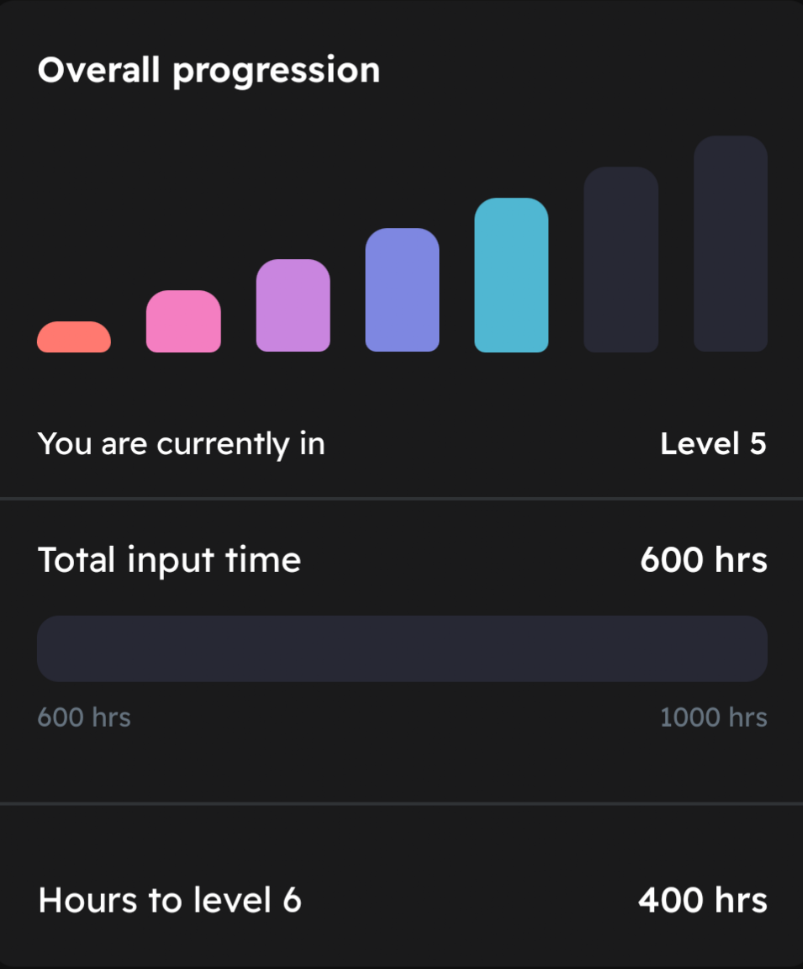
The next Dreaming Spanish level is another 400 hours away.
That sounds enormous because it is.
Learning a language has turned out to be a vastly bigger commitment than I appreciated when I started.
But I don’t want to spend the next 400 hours constantly searching for new content, worrying about whether something is exactly the right difficulty, or obsessing over when I’ll reach the next milestone.
I have more than enough Spanish available to me now.
I want to settle into the routine, stay focused, keep listening and reading, continue the crosstalk conversations, and let the process do its work.
I’m nowhere near finished.
But the path is paved and lit.
-
This isn’t limited to native content. Two Dreaming Spanish videos rated 75 felt radically different to me: Agustina’s clear pacing and explanation made hers feel easy, while Tamara’s more theatrical, scattered delivery and a story involving several generations of family made hers much harder to track. Difficulty ratings are useful as a ballpark, but speaker and subject matter can move the subjective difficulty enormously. ↩︎
Comments