Proof
Snapshot
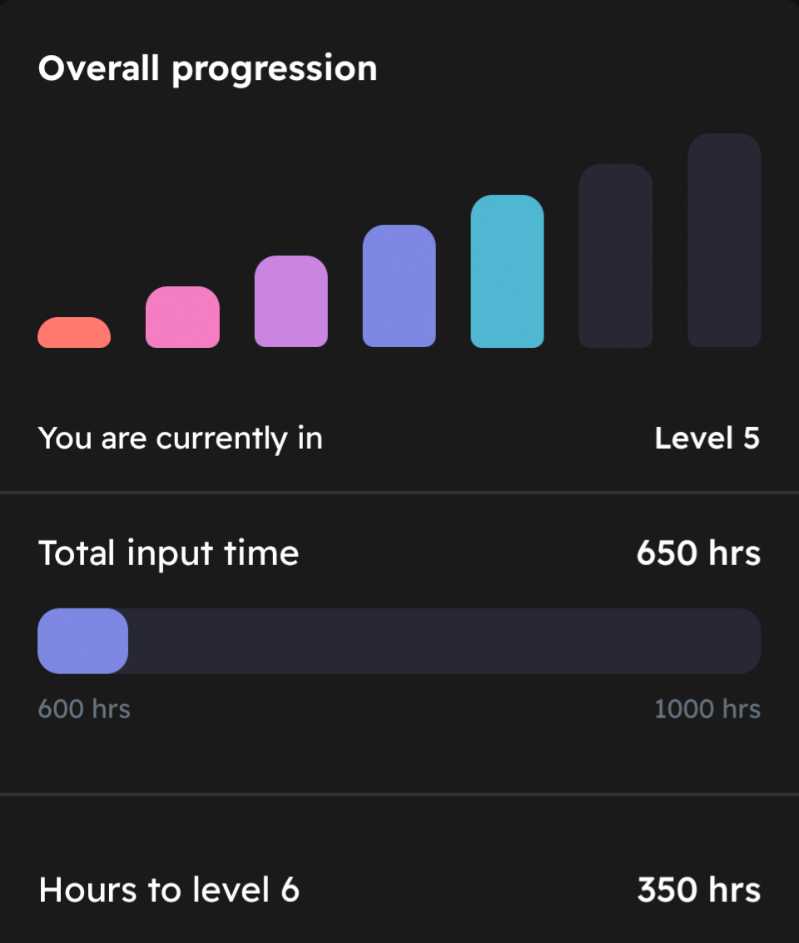
- Listening hours: 650, currently Dreaming Spanish Level 5.
- Daily input since 600: ~2.3 hours per day.
- Main input: Dreaming Spanish, especially a rotation of intermediate series and podcasts.
- Other listening: Native YouTube content about chess, philosophy, food, travel, and literature.
- Books finished: 18 in Spanish so far. During this stretch, I finished Como agua para chocolate and Manolito Gafotas.
- Currently reading: Cajas de cartón.
- Crosstalk: Four sessions completed, still responding mostly in English.
- Overall feeling: Comfortable with most learner content, increasingly able to enjoy native material, and more concerned with sustaining attention than constantly measuring difficulty.
What’s Improved
Fifty hours into Level 5, and this stretch has felt less like crossing dramatic thresholds and more like settling into something that already works.
Several of my notes during this stretch were essentially: still listening, still reading, still enjoying it, not much new to report. But looking back through the notes, there’s more here than it felt like at the time. I’ve finished two excellent books, started another, watched more native content about things I genuinely care about, continued crosstalk, and even helped resolve a minor delivery problem using Spanish.
At the beginning of this stretch, shortly after celebrating 600 hours, Dreaming Spanish informed me that I had 397 hours until Level 6. Congratulations on all that effort. Please do a substantial portion of it again.
That’s part of why I like these fifty-hour updates. The next big milestone is distant, but these smaller intervals let me capture what the process actually feels like along the way.
The most noticeable listening change hasn’t been suddenly understanding a whole new category of Spanish. It’s been hearing more detail inside material I could already broadly understand.
I’ve watched a lot of intermediate content because many of the Dreaming Spanish podcasts and series I enjoy are at that level. Some of it now feels slower. More importantly, I’m hearing more of the little connective phrases: things like en los que, en lo que, and the combinations of small words and pronouns that can disappear into the overall flow.
Previously, I might have understood the sentence without really hearing all of that. Now, sometimes, more of the actual phrasing comes through. It’s a subtle shift from following the general meaning toward hearing more precisely how that meaning is being expressed.
I don’t want to oversell it. This isn’t happening perfectly or constantly, and I can’t put a reliable number on the improvement. But it’s something I’ve started noticing.
With learner content more generally, I can put on most things that interest me and expect to follow them. There are still missed phrases and occasional lost threads, but those increasingly feel like interruptions in otherwise comfortable listening rather than the defining experience.
What’s Still Hard
The biggest recurring challenge is staying interested and paying attention.
Some days, the material is perfectly understandable, but my mind is somewhere else. I can be listening to Spanish while thinking about work, another conversation, or whatever else is occupying me. Eventually I realize I don’t know what the speaker is talking about anymore.
I’m trying to get better at choosing something that genuinely interests me, at a time when I can give it my attention. Having a video playing isn’t quite the same thing as listening to it. At the same time, I don’t want to replace my old comprehension obsession with an equally exhausting demand for flawless concentration.
Native speech still presents plenty of actual language difficulty, too. Sometimes it’s vocabulary I don’t know. Other times, I know the words perfectly well on the page but don’t recognize them quickly enough when they’re compressed together in speech.
A lo mejor was one small example. It’s not an unfamiliar expression, but in fast conversation it can vanish before I’ve identified it. Subtitles make these moments obvious: suddenly the mysterious sound is a perfectly ordinary phrase.
Understanding something with subtitles also isn’t the same as understanding it without them. They’re helping me access interesting material, but the gap is still there.
What I’m Doing Now
Rotating through several Dreaming Spanish series continues to work well.
Watching a whole series consecutively initially seemed like an excellent way to eliminate decision fatigue. It was, but I discovered that the same subject or emotional tone can get tiring. An intermediate series built around complaints was enjoyable in individual episodes, but a long uninterrupted sequence of grievances became a bit much.
Now I watch an episode from one series, then something from another, and keep cycling. That gives me variety without sending me back into endless browsing.
I also match the format to what I’m doing. Audio-heavy material works well on walks and during cooking or cleaning, provided I can actually follow it. When I’m at the computer, I tend to watch things with more of a visual component, especially travel series. New Dreaming Spanish podcasts and the occasional YouTube discovery interrupt the rotation naturally.
I’m still enjoying Erre que ELE’s content, particularly the videos about sayings and expressions. I like her accent, pacing, and the fact that the content itself is interesting to me.
The routine isn’t especially elaborate, which is probably why it’s lasting.
Native content is becoming part of the mix
The most exciting additions have been videos I would plausibly watch in English anyway.
Chess has been particularly fun. I watched Anna Cramling speaking Spanish and was struck by how different her delivery felt to me. Then I started watching more Pepe Cuenca. I’d enjoyed his English-language banter blitz videos before, but in Spanish I find him even more animated and hilarious. The way he describes situations on the board is fantastic, and I love his Granada accent.
Knowing the subject gives me something solid to hold onto while following the language. I’m not just trying to understand Spanish. I actually want to hear what he says about the position.
I’ve also watched a long pizza-making video from Eric Ayala, a philosophy video about gatekeeping the subject from a creator with a lovely, clear Rioplatense accent, and an interview with a Spanish author my father-in-law sent me.
That interview was a particularly satisfying experience. I estimated that I understood around 70% without subtitles, although these percentages are impressions, not measurements. Some unfamiliar vocabulary, including a nautical analogy, gave me trouble. The older speaker’s voice also took some adjustment. But I could follow enough to get something meaningful from his ideas.
Long-form explanations seem especially helpful right now. When someone spends time developing a point, I have a chance to recover from something I missed. The next sentence might explain it differently or supply an example. A brief exchange can end before I’ve caught up, whereas a sustained discussion gives me more opportunities to stay involved.
Another useful comparison came from a Sevilla/Jerez conversation I watched earlier in this stretch. Similar material had once felt nearly impossible even with subtitles. This time I could follow most of it with them and perhaps 60% without. There was still plenty I missed, but it no longer felt inaccessible.
And I continue to find Andalusian accents beautiful. That makes returning to challenging material much more appealing.
Reading
Reading has been one of the most rewarding parts of these fifty hours. I’ve now finished 18 books in Spanish, which still feels slightly ridiculous to see written down.
Finishing Como agua para chocolate
I finished Como agua para chocolate and thought it was spectacular.
The structure, symbolism, characters, magical realism, and food imagery all contributed to an experience I genuinely loved. There was a lot of looking things up, particularly specialized vocabulary and the more ornate descriptive language, but that never stopped it from being an enjoyable book.
As I progressed, I also found longer stretches of flow, especially in dialogue and straightforward descriptions of events. The denser passages remained slower, but I wasn’t having the same reading experience on every page.
I was reading roughly a chapter a day. By the end, my main reaction wasn’t satisfaction at having completed a difficult Spanish exercise. It was enthusiasm for a fantastic novel.
Manolito Gafotas
After that, Manolito Gafotas felt much easier.
It was still clearly harder than a graded reader. There were unfamiliar expressions, regionalisms, and jokes that required some investigation. But the overall experience was smoother, lighter, and genuinely funny.
The narrator’s voice is wonderful. His relationship with his brother, his friends, and his grandfather feels so convincing, and his ability to talk endlessly about himself is hilarious. The scene where he and his grandfather gawk at a television personality on the Gran Vía, and the episodes involving his psychologist and autobiographical notebooks, were particular highlights.
My earlier reading helped here. Juan’s books and the Spain-focused expression videos had already introduced me to some of this colloquial language, so it wasn’t all arriving from nowhere.
One especially enjoyable moment involved Manolito saying something about la falta de gravedad, only for his friend to repeat it later as la falta de variedad. I caught the mistaken word and the joke on the first read. A small thing, but a satisfying one: the humor landed directly in Spanish.
I finished the book wanting to return to the series eventually (there’s 7 more books!). Having more of these characters available sounds like a good option between heavier books.
Starting Cajas de cartón
I’ve now started Cajas de cartón, and so far it seems like a good fit.
The prose feels more direct and less ornate than Como agua para chocolate. There are unfamiliar words and verbs, but I can read substantial stretches without losing the story.
I read the second chapter in print without looking anything up. There was quite a bit of vocabulary I didn’t know, particularly in the descriptions of picking cotton and caring for the narrator’s younger brother. Nevertheless, I could follow what was happening.
That was an interesting experience: not understanding every action word, but still understanding the sequence of events well enough to keep reading. The short chapters help keep that uncertainty manageable.
I’m curious enough to go back and look up some of those words, but I didn’t need to resolve everything before continuing.
Finding my own approach to lookups
I’m increasingly comfortable treating lookups as part of reading rather than something to avoid on principle.
I enjoyed investigating words and references while reading in English. There’s no reason to forbid myself that pleasure in Spanish. The question is whether it helps me enjoy and understand the book or starts replacing the reading itself.
One useful encounter was si no hubiera sido porque. I reread the sentence, guessed the meaning incorrectly, then looked it up and reviewed it. I may well have heard that construction before, but this was the first time I really noticed it.
Reading gave me time to stop and make sense of something that could easily pass unnoticed in speech. I’m interested to see whether it becomes easier to recognize when I hear it again.
For now, I’m continuing with literature rather than returning to graded readers. Antes de ser libres and Solito are still possibilities for later, but I’m happy to see how the current book goes first.
Crosstalk
I’ve now done four crosstalk sessions, and they continue to offer something different from watching videos.
One conversation ranged across labor history, immigration, religion, books about Spain, nonverbal communication, and regional accents. I was engaged, understood nearly everything, and wasn’t watching the clock. When I did check, about 45 minutes had already passed.
The real-time responsiveness is valuable. I have to understand enough to make a relevant reply, and what I say gives the other person some indication of whether I’ve followed.
That’s different from privately turning every video into a proficiency exam. The comprehension check is part of having an actual conversation.
I’m still responding mostly in English, but little bits of Spanish are appearing naturally. Sí, sí, claro comes out frequently, and occasionally another phrase slips in when it fits. I’m not trying to turn the sessions into forced speaking practice, but it’s interesting to notice those small responses becoming available.
I haven’t decided how long I’ll continue crosstalk. For now, I’ve enjoyed it and can see what it adds.
Notable Moments
A small delivery problem gave me an unexpected opportunity to use Spanish outside the learning routine.
A friend was struggling to communicate with a Spanish-speaking delivery driver who couldn’t find the apartment. I joined the call and understood that the driver was at the cancha de tenis. I tried giving directions, although getting the words out took longer than understanding what he was saying.
There was some confusion about which entrance to use. The driver said there were four: ¿Qué puerta? I didn’t manage to direct him perfectly, but knowing he was at the tennis court let my friend go and find him.
It was a modest success, but a real one. My comprehension helped solve the problem even though my spontaneous speaking was much less comfortable.
There have also been smaller cultural discoveries. I’ve watched some Spanish shorts, mostly about food, without tracking them. One bilingual creator introduced me to Rata de dos patas, which was quite a discovery. Not everything worthwhile arrives as a carefully selected hour of input.
And while watching that philosophy video, I had a moment of simply appreciating what was happening. I was listening to someone discuss a subject I care about, in Spanish, and understanding a substantial amount. There’s a long way to go, but occasionally the distance already traveled becomes surprisingly obvious.
A Broader Perspective
I’m looking forward to visiting Miami with my daughter and in-laws around New Year’s.
On previous visits, particularly around Hialeah, the amount of Spanish I heard made a strong impression on me. Being addressed in Spanish by default was unfamiliar, and every visit made me want to learn.
Returning with considerably more understanding should be a richer experience, especially around family. I’m curious about what I’ll catch that I couldn’t before.
I don’t want to turn the trip into another exam, though. It’s an opportunity to participate more, not a deadline by which Spanish needs to be finished.
Takeaway
The biggest change in this stretch may be that I no longer need every video to tell me whether I know Spanish yet.
Earlier, there was often a little assessment running alongside the listening: Do I get it now? Has it finally clicked? Does this video prove I’m improving?
That has eased. I’m more comfortable with the idea that there isn’t a single switch waiting to flip. There are familiar phrases becoming clearer, unfamiliar voices becoming easier to follow, books becoming more readable, and occasional practical situations where the language works.
I still need plenty of listening, and speaking remains much less developed. The challenge now is keeping the process interesting and sustainable enough to continue, while actually paying attention to what I’m consuming.
My plan is still to reach 1,000 hours and reassess. For now, the fifty-hour checkpoints give me somewhere to pause and notice what’s happening without demanding a transformation every day.
At 650 hours, Spanish is still something I’m learning. But it’s also increasingly something I can use to enjoy a book, laugh at a chess commentary, or hear an idea I wouldn’t otherwise have encountered.
That’s plenty of reason to keep going.
Comments