Proof
Snapshot
- Main input: Dreaming Spanish
- Daily input: ~3h 30m
- Additional input: Español con Juan, My Spanish Flow, graded readers (working on these two A2 level readers right now)
- Current feeling: less easily thrown off by difficult content, more able to stay engaged despite imperfect comprehension
- Context: final update before my trip to Spain
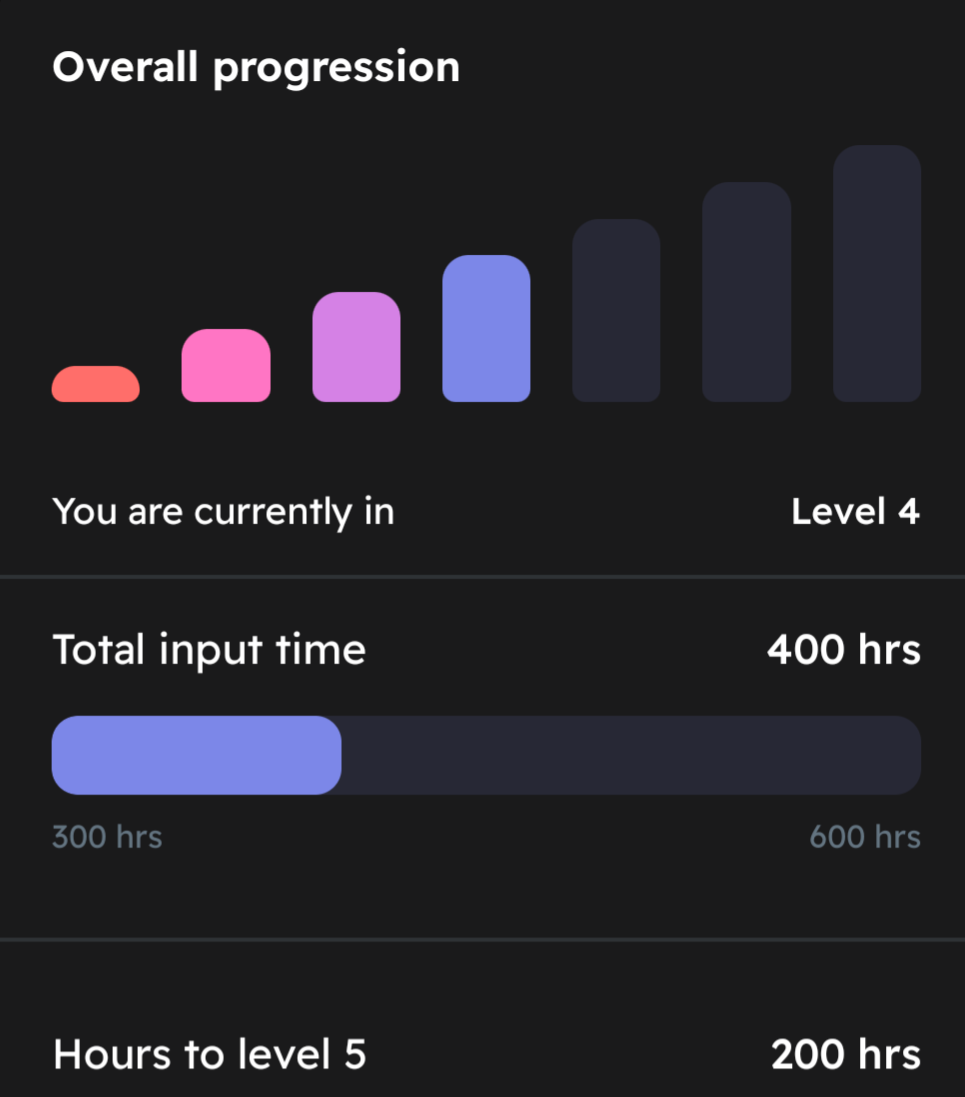
Months ago, I was hoping I might reach 300 hours before leaving for Spain. Instead, I arrived at roughly 400 hours. That’s a significant milestone for me because I’ve never gotten this far with a language before. Previous attempts consisted of classes, short bursts of enthusiasm, or half-hearted efforts that eventually faded away.
This time feels different.
What’s Improved
The biggest improvement is not vocabulary or grammar in isolation. It feels more like my brain is becoming faster at orienting itself inside the language.
I am more quickly identifying who is doing what to whom in a sentence. Earlier on, I could understand many individual words while still losing the structure. Once I misunderstood the subject or object, my predictions about where the speaker was going could completely derail. That still happens, but less often.
I also feel much faster with many common verbs. Verbs like saber, encontrar, pedir, poner, llevar, llegar, dar, salir, quedar, and dejar feel more intuitive than they did 50 or 100 hours ago. Some of these have many different uses, but they increasingly feel like digested pieces of the language rather than isolated dictionary definitions I have to translate to English first before I get my bearings.
Reading has likely contributed to this. I only read a little most days, but it seems to help reinforce word recognition, phrase recognition, and familiar patterns that later show up during listening.
I also feel more capable of tolerating ambiguity. Earlier on, missing a few details could make an entire video collapse. Now there are more situations where I can continue following the conversation without understanding every word.
There are videos where I feel genuinely locked in. I watched an intermediate Dreaming Spanish video about web development and understood almost everything. I increasingly find myself following intermediate content in the 60 to 75 difficulty range with a very high level of comprehension, around 85 percent or more.
One particularly strange moment happened right before reaching 400 hours. I was watching a Spanish YouTube video about taking the train from Madrid to Seville. For a brief moment, I could have sworn the speaker was talking in English because I understood it so immediately. I rewound the video and of course it was entirely Spanish. The experience only lasted a second, but it felt like evidence that sometimes my brain is processing Spanish directly as meaning rather than consciously decoding it as a foreign language.
What’s Still Hard
Progress remains extremely uneven.
I can understand one video effortlessly and struggle badly with another that has a similar difficulty rating. For example, I watched an advanced Dreaming Spanish discussion about AI and could not make it past five minutes. Shortly afterward, I watched an intermediate video with Agustina and Gustavo at a McDonald’s shaped like an airplane in New Zealand and found it almost perfectly comprehensible.
I also watched two intermediate videos where Michelle interviewed a Mexican boy who was ten and struggled considerably despite it being excellent content. Topic familiarity, speaking style, accent, age, and background knowledge all seem to matter tremendously.
Numbers remain surprisingly difficult. Numbers in the hundreds, spoken quickly, can still completely scramble my brain, especially without subtitles.
Speaking also remains far behind comprehension. There is still a large gap between what I can understand and what I can produce spontaneously. When speaking, I rely too much on translating internally from English to Spanish and often find myself uncertain about phrasing, conjugations, and grammar.
Once I start doing a little speaking it becomes hard to turn it off even though it’s a struggle and I know the fluency and word recall will come with time. I also sometimes distract myself by trying to formulate Spanish responses while listening or reading. This usually hits a wall rather quickly and reminds me that my primary job right now is still to listen and understand.
Maintaining focus is another challenge. Some days I pause frequently, rewind, lose the thread of a video, or feel overwhelmed by the sheer size of the task ahead. On my most despondent days I have to re-read my intro post and remind myself to stay patient and why I started acquiring Spanish in the first place.
What I’m Doing Now
Dreaming Spanish remains the foundation of my input, but I have started branching out more.
One pleasant surprise has been Español con Juan. His videos often explain grammar entirely in Spanish through examples, stories, and repetition rather than English explanations. What I appreciate most is that it feels less like studying grammar and more like stabilizing patterns that already exist vaguely in my mind from hundreds of hours of exposure.
I have also started watching videos from My Spanish Flow, which uses a similar approach, e.g., in this video. These channels have been a nice way to diversify my input without abandoning comprehensible input principles.
Reading continues to be part of my routine. I finished another Olly Richards graded reader and realized that his stories are probably not for me. I find them a bit too intentionally quirky. The books by Juan Fernández fit my tastes much better because they feel more natural and engaging.
At this point, A1 readers seem too easy. A2 and B1 readers feel like the sweet spot for me right now.
I also continue trying to avoid subtitles when possible. One thing I have noticed is that subtitles encourage me to read ahead. If I encounter an unfamiliar word before hearing it, I become distracted by it and stop listening naturally. Listening without subtitles feels more immersive and allows meaning to emerge more naturally from context. Plus real time doesn’t come with subtitles so I try to ride without training wheels as much as possible.
Notable Moments
One of the most encouraging experiences of this stretch involved a video with Agustina and her father Gustavo about Gen Z slang. Apparently I had attempted the video in the past and stopped around the 90 second mark. This time I watched the entire 23 minute video.
Gustavo’s pronunciation was still difficult at times and there was plenty of unfamiliar vocabulary, but I could stay engaged and continue following the conversation. That felt like meaningful progress.
Another recurring lesson came from Pasapalabra. In one episode I got most of the answers wrong (I try to guess the words before the contestants guess them) despite performing better on previous episodes. Rather than viewing this as regression, I came to see it as evidence that the show tests a very different collection of skills: vocabulary recall, wordplay, spelling, definitions, and cultural knowledge. Plus, in more recent episodes I did much better, which is another reminder to avoid concluding too quickly that a tough stretch of days says anything negative about my long-term progress.
The most consistent theme of this entire stretch has been oscillation. Some days I feel highly competent and deeply connected to the language. Other days I feel as though I can barely understand anything. Yet underneath those fluctuations, there seems to be a growing stability.
Takeaway
The progress from 350 to 400 hours feels increasingly uneven on the surface but increasingly stable underneath.
There were moments of doubt. There were videos I could barely follow. There were times when I wondered why I was doing this at all. Learning a language can feel overwhelming when I focus too much on the distance still remaining.
But I repeatedly found my way back to the same realization: this is something I have wanted to do for much of my life, and meaningful progress comes from patience and consistency rather than intensity.
A difficult video no longer convinces me that I am failing. A confusing conversation no longer feels like evidence that I have learned nothing.
The language is still vast. There is still a tremendous amount left to acquire.
But compared to where I started, I am increasingly able to trust the process and keep moving forward.
Comments