Proof
Snapshot
- Main input: Dreaming Spanish
- Daily input: ~2h 30m
- Main listening: Longer podcasts, discussions, and series
- Main reading: A2 and B1 graded readers
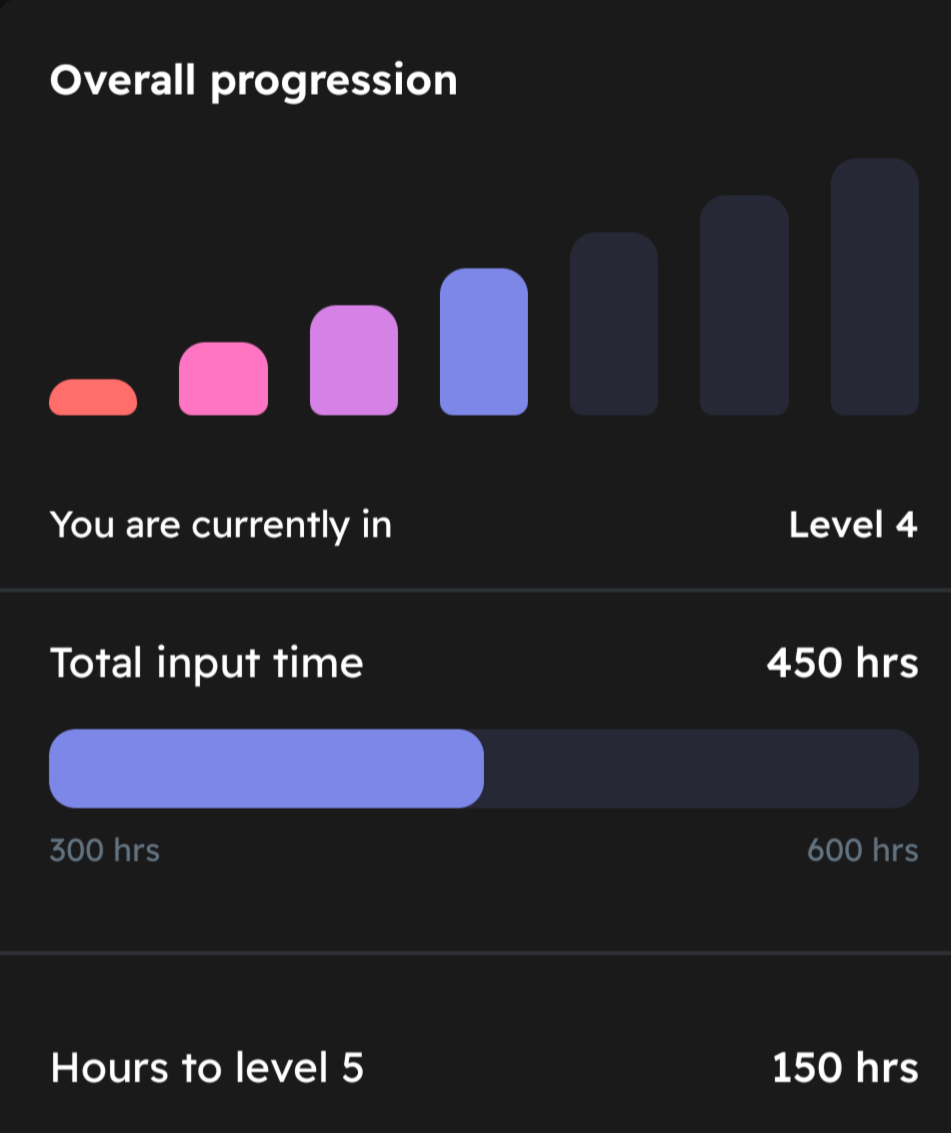
450 Hours
The last fifty hours felt different from the previous fifty.
At 400 hours, I remember feeling excited about how much progress I’d made, but also overwhelmed by how much remained. Four hundred hours is a lot of time. At the same time, one thousand hours still felt incredibly far away.
That feeling hasn’t disappeared entirely, but something has changed. I increasingly trust the process itself. I’ve accumulated enough hours at this point that thinking back to even just a few months ago it’s obvious how much I’ve already acquired. I can clearly tell that it’s working which is the kind of positive feedback loop needed to keep a lengthy learning process like this moving ahead. I don’t spend as much time wondering what I should be doing or constantly searching for the right video. Most days the answer is simple: listen to Spanish (in the 50 to 70 level but occasionally higher or lower for variety), read Spanish (A2 and B1 graded readers), and continue accumulating input.
The progress from 400 to 450 hours also felt quieter than previous milestones. There were fewer dramatic breakthroughs and more gradual refinement. Instead of constantly discovering new abilities, I spent this period learning what kinds of Spanish feel comfortable, enjoyable, and sustainable.
Developing a Better Sense of My Current Level
One thing that became much clearer during this stretch is where my listening comprehension currently lives.
I listened to a Dreaming Spanish podcast about the languages people want to learn in Latin America that was rated 59. I understood essentially everything. Occasionally I rewound a section, but every time I did, I immediately understood what I had missed.
I watched Agustina’s video about things that surprised her in Panama, rated 57, and again understood almost everything.
I listened to a podcast nearly forty minutes long featuring Agustina and Shel discussing culinary differences between Argentina and Colombia. Afterward I checked the rating and discovered it was a 60. Aside from a handful of unknown words, it was completely comprehensible.
Experiences like these are becoming increasingly common.
At the same time, I watched an advanced video featuring Andrés and Michelle rated 82 and probably understood something closer to 60%.
I also watched a pair of videos rated 67, one about aliens and one about international dating. Both felt excellent for my current level. I probably understood around 85% and was able to comfortably ride through any unknown sections without losing the thread of the discussion.
Later I watched two videos in the 70s. One discussed the weather in Buenos Aires. The other was a story from Andrés involving escaping naked down a fire escape. Both were challenging but worthwhile. I never felt lost enough to stop watching, but they required noticeably more concentration.
Speaker, Topic, and Format Matter
What I’ve realized is that my comprehension isn’t determined solely by a difficulty rating. At earlier stages, I tended to think of Spanish as a single skill that either worked or didn’t. Now the picture feels much more nuanced. Both the speaker and the topic matter, as does the format. A conversation of forty minutes between familiar guides can feel almost effortless, while a shorter video with a different speaker can be surprisingly challenging. I’m becoming less interested in whether content is objectively difficult and more interested in understanding what specifically makes it easy or hard for me.
During this stretch I became much more aware of why certain content feels easier or harder.
There are several guides whose content now feels consistently accessible. Agustina, Shel, Natalia, Alma, Sandra, and Pablo all fall into that category.
Michelle remains difficult for me.
What’s interesting is that the challenge often doesn’t feel linguistic. It feels auditory. Sometimes her speech trails off, becomes softer, or blends together in a way that makes it difficult for me to identify word boundaries.
Street interviews remain challenging for similar reasons. The problem often isn’t vocabulary. It’s processing unfamiliar voices, accents, rhythms, and speaking styles.
Topic matters too.
The weather video was easier than the Andrés story, even though both were similarly rated. Informational content gives me more opportunities to predict what kinds of ideas and vocabulary are likely to appear. Stories are more open. They force me to pay closer attention because the conversation can go anywhere.
Series Finally Clicked
For most of my journey I accumulated a huge playlist of videos and picked from it somewhat randomly.
This period was different.
I spent more time watching series. One series that stands out especially is Pablo’s series about how to learn a language
One day I simply put it on during a walk and let it autoplay.
That turned out to be one of my favorite ways to consume Spanish.
Series provide something I hadn’t fully appreciated before: stability. Once I find a series at a level I enjoy, I can stop worrying about difficulty ratings and simply consume the content.
In a strange way, the discovery wasn’t that series are useful. The discovery was that I don’t need every piece of content to push my limits.
Some Memorable Series
On the off chance this is useful to someone at some point, some of my favorite series for the last 50 hours:
- Rude Reviews with Agustina where she critiques the interior design choices of celebrities. Not something I would normally seek out but her presentations are excellent. Hearing her talk animatedly about terrible couches and lamps is a very memorable way to consume excellent intermediate content
- Explore Central Asia with Agustina and her father Gustavo is incredibly well produced and researched. This is not a region of the world I know much about or would’ve thought to explore but the content is engaging, both in general and from a language learning perspective. Plus, anything with Gustavo is essential viewing for me. I similarly recommend the hotel reviews Agustina does with her dad about the places they stayed in during their trips throughout central Asia
- Explore Sevilla with Andrés where he explores different places in Sevilla and even interviews some of the locals (in a bar, in a university, etc.). I love the accents there and find Andrés’ content to be of a consistently high quality, both humorous and thought provoking. After seeing Sevilla in these videos, it’s definitely on my list of places to visit in the future if fate allows
Reading Is Becoming More Important
The other major development was reading.
I finished El peor día de mi vida by Juan Fernández and highly recommend it. It was genuinely funny at numerous points; Juan’s plots are hilariously zany with a bit of a dark humor. If you like his YouTube videos you’ll love this book.
At a B1 level, the book was generally accessible, but every couple of pages there would be a sentence that forced me to slow down and think.
One example was:
Estaba seguro de que yo también le gustaba a ella.
There was nothing especially advanced about the vocabulary, but the sentence required me to carefully track who liked whom.
I also loved the vocabulary sections at the end of each chapter. Within each chapter there are some bold words and phrases; at the end of the chapter these are defined. Rather than translating into English, Juan explained them in Spanish. Reading definitions in Spanish was surprisingly enjoyable.
After finishing the book, I moved to an A2 reader called Un hombre fascinante.
Interestingly, this produced a realization.
The B1 reader was more interesting. The language was richer. The stories were more sophisticated. There was more linguistic variety.
But the A2 reader flows.
Reading feels almost effortless.
It sits right on the edge of being too easy, yet it provides exactly the kind of reading experience I currently want. I have two more A2 readers lined up before returning to another B1 book.
This feels similar to what I’ve discovered in listening. The most beneficial material isn’t necessarily the hardest material I can survive.
Extensive Reading and Building a Reading Tracker
Reading also became more concrete during this stretch.
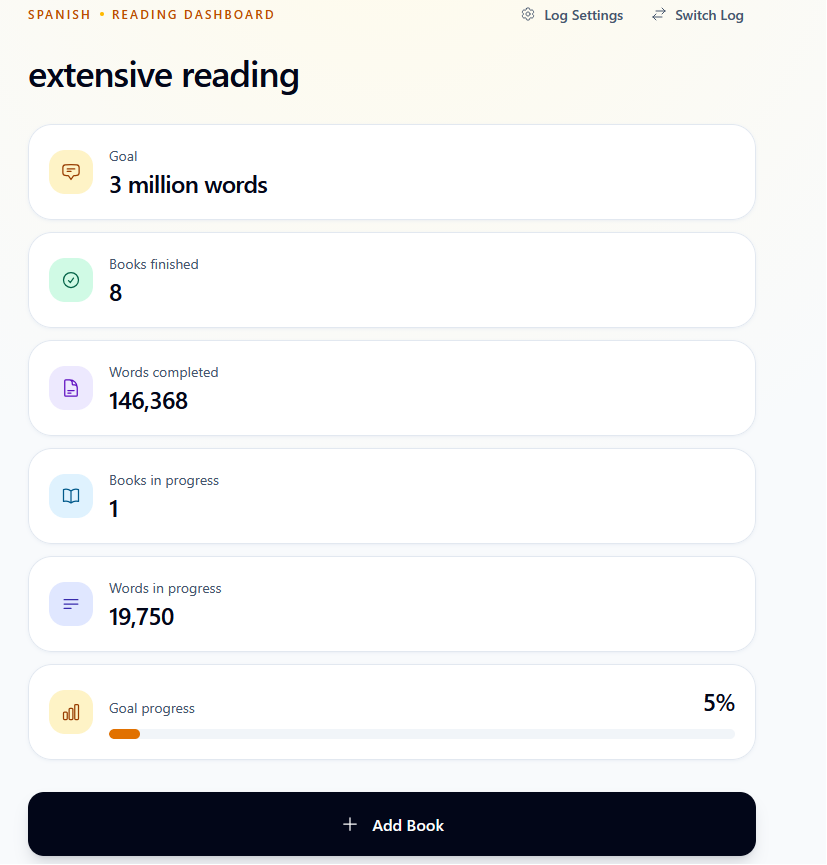
After learning more about research on extensive reading and encountering recommendations involving millions of words of reading, I wanted a way to track progress over time.
I ended up building a local reading tracker application.
CI Book Tracker
The project tracks books, estimated word counts, reading goals, and overall progress.
In some ways the application itself isn’t the important part.
The important part is that reading now feels like a permanent part of my language learning process rather than something I occasionally experiment with.
Revisiting Old Territory
One of the most satisfying moments happened completely by accident.
While visiting Lakeshore, while my wife and daughter shopped, I picked up several bilingual children’s books (they were in English and Spanish) and started reading them.
I had done this before six months ago when I went to Lakeshore for Christmas presents. At that point I was still doing Duolingo and on the cusp of starting comprehensible input. As you might imagine, I understood almost nothing.
This time the experience was completely different.
One of the books I read this time was Hands Are Not for Hitting which is for ages four to seven.
The book felt comfortable and straightforward. It was exciting to think back and notice how much my comprehension has improved since I started acquiring Spanish.
It might sound silly to be proud of a first grade reading level but it’s actually surprisingly involved. Moreover, my language level isn’t even at the level of my first grader yet. Native children at that age possess a much larger vocabulary, stronger grammar intuition, and vastly better speaking ability than I do.
But it felt very motivating to comfortably comprehend children’s books that once felt nearly inscrutable.
Spanish Is Becoming a Source of Discovery
Another memorable moment came through Español con Juan.
A video about using que + subjunctive to express wishes led me to Joaquín Sabina’s song Noches de Boda.
I was already a fan of Sabina because of Contigo, but Noches de Boda immediately became another favorite.
Experiences like this feel increasingly important.
Spanish is no longer only something I study. It is increasingly a source of books, music, stories, and ideas that I genuinely enjoy.
Native Speakers Are Not Dictionaries
One funny interaction involved the word cubo.
Months ago I had looked up the word for bucket and learned that cubo could mean bucket.
Recently, a native speaker insisted that cubo did not mean bucket and that cubeta was the correct word.
I immediately doubted myself.
Later I looked it up and discovered that both words are used, depending on region.
The lesson wasn’t that the native speaker was wrong.
The lesson was that native speakers are experts in their own variety of Spanish, not necessarily every variety of Spanish.
Looking Ahead
Perhaps the biggest lesson of the last fifty hours is that I am becoming more aware of my own comprehension.
A few hundred hours ago most content fell into two categories: understandable and not understandable. Now the picture is more nuanced. My comprehension varies with the speaker and the topic, and informational content lands differently from stories.
I can identify where my comfort zone currently lies and where the edges begin.
I know how big of a task acquiring a language is and how much more I have to go but I’m not discouraged.
Most importantly, I continue to trust the process because I can see the progress. So I know I can be patient. There’s no rush.
This milestone is also arriving at an interesting time. In about a week I’ll leave for Spain. For two weeks I’ll be surrounded by the language I’ve spent the last nine months listening to.
The trip will completely interrupt my normal routine but in the best possible ways.
Then I’ll come home and start accumulating hours again.
Comments