Proof
Snapshot
- Main input: Dreaming Spanish
- Daily input: ~1h 30m
- Reading: 11 graded readers completed, about 207,500+ words tracked
- Current reading level: B1 feels smooth; considering trying B2 soon
- Recent milestone: Two weeks in Spain using Spanish in real situations
- Current feel: Functional but foggy in the wild; increasingly comfortable and automatic with comprehensible input
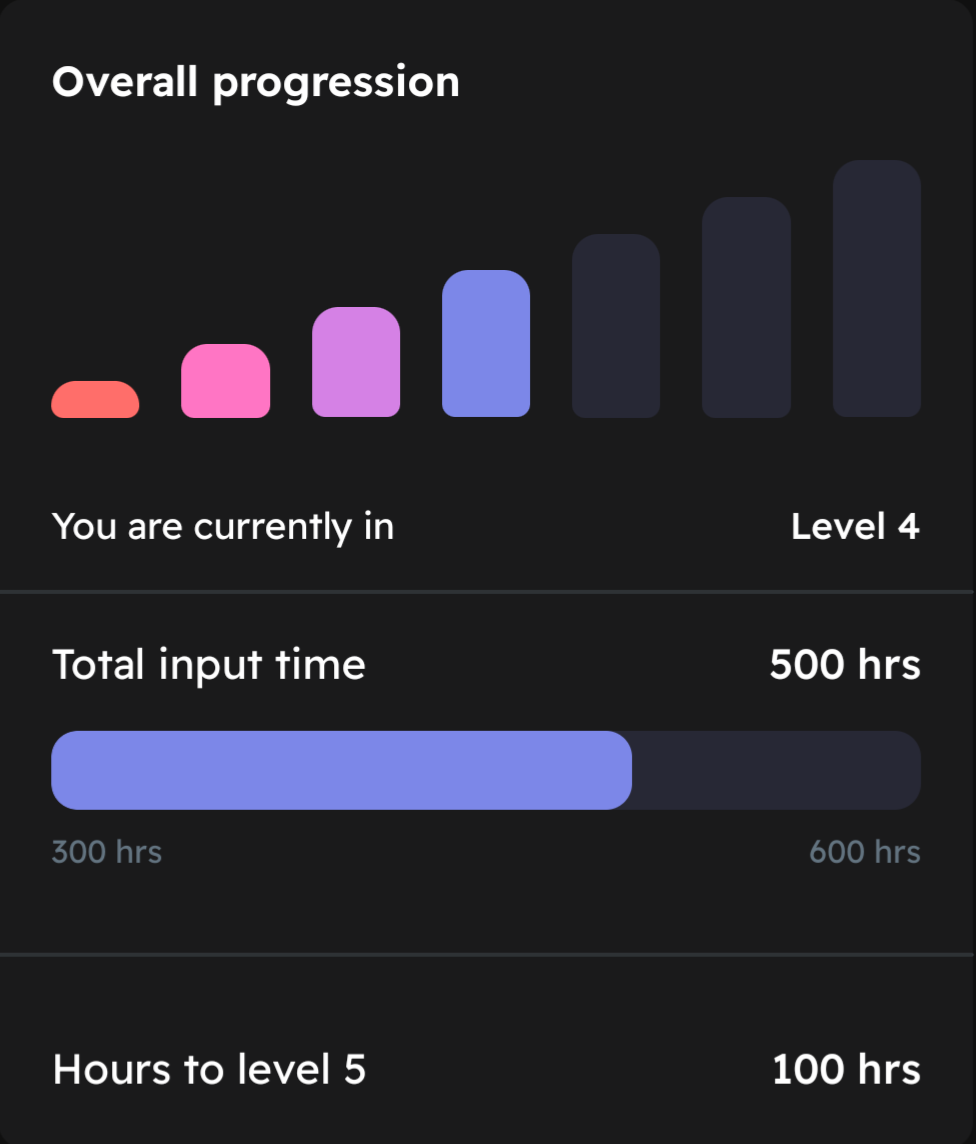
While not a new DS level, I am now at what feels like a significant milestone: 500 hours of Spanish input.
The last fifty hours have been different from the earlier milestones because they included my first trip to Spain1 since starting comprehensible input (my first trip there ever). That gave me the clearest test so far of what my Spanish actually is outside of videos, podcasts and graded readers.
The result is complicated, but in a good way.
Speaking Spanish in the Wild
My Spanish is real now. It is practically useful. I can buy things, ask questions, follow conversations, make small jokes, and have brief human exchanges that I would not have been able to have before. But it is also very incomplete. It is foggy. It is uneven. It disappears when I am tired. Sometimes I understand enough to continue but not enough to feel confident that I got all the details right.
The best phrase I found for this level and my ability in Spain was successful but foggy.
That may sound like a contradiction, but it describes the experience almost perfectly. I could often do what I needed to do. I could get through the interaction. I could buy tickets, order food, ask about ingredients, buy medicine, mail postcards, buy lottery tickets and talk to taxi drivers. But under the surface I was often guessing and reconstructing, missing pieces while hoping I had understood the important part.
To someone watching from the outside, especially my father in law who speaks Spanish natively, it could look like I knew more than I did. He kept telling me that I had Spanish, that I understood, that I was doing fine. I appreciated the encouragement, but internally I kept thinking, no, not exactly. I am not a beginner anymore, but I am not where I want to be. Not even close.
That is not discouraging. It is just clearer now.
Before the trip, I was nervous about people starting conversations with me. In a comprehensible input video, there is always context. There is a title, a thumbnail, a known speaker, a topic, a certain kind of pacing. Even if the video is advanced, I know roughly what world I am entering.
Real life is not like that. Sure, with commercial interactions there is some constraint on what will probably be discussed, but it is dynamic and unscripted. Someone says something while walking away. A waiter asks a question I was not expecting. A cashier makes a comment. A taxi driver shifts from football to work to where I am from. If I miss the first phrase, I can suddenly feel as if the whole interaction has started without me.
That fear turned out to be both accurate and overstated.
Making Repairs
There were definitely moments where I missed the beginning of something and felt lost. But there were also many times where I recovered. I learned that I do not need every word to keep going. I need enough context, enough patience and enough willingness to ask again.
One of the funniest lessons came at a restaurant. After I ordered, the waiter asked me something with the word encima. I did not hear the beginning of the question, but instead of asking for clarification, I foolishly said sí. A few minutes later I had cheese on my dish, which I did not want.
That was a small and stupid price to pay for an important lesson. Never use sí as a panic button. Especially in a restaurant. Sí can mean yes, put cheese on it. Sí can mean yes, make it spicy. Sí can mean yes, give me the larger one. Sí can mean yes, charge me for a thing I did not understand. I learned that if I do not understand the question, I need to ask. Perdona, no te he entendido. Or, ¿Me lo puedes repetir? ¿Encima de qué? Anything is better than consenting to a mystery box of options.
I also had some good repair moments. In a tobacco shop, I wanted to buy stamps to send postcards home. I said something like, Necesito comprar estampillas, and the woman pointed me toward postcards. That made sense. I was in a shop that sold postcards and I had not used the correct word for stamps. So I grabbed a postcard, flipped it over, pointed to the little area where the stamp goes, and said again, Necesito esto. Then she immediately said, Sellos, sellos, and we were fine. She asked where I was sending the postcards how many stamps I needed and the rest of the interaction worked.
That was encouraging because I did not collapse after the first misunderstanding. I changed strategy. I used the physical context. I learned the word in the exact situation where I needed it.
Another repair happened at the end of the trip with a taxi driver in Madrid. I was trying to ask whether he had a union job and used the word sindicalizado. He did not understand what I meant. Maybe the word itself was not the issue, but the way I framed the question did not fit the situation. So I asked if he worked for himself. I said something like, ¿Trabajas por ti mismo? It was not the most natural version, but it worked well enough. He explained that he was salaried and worked for a company.
Later I realized that a more natural way to ask would be, ¿Trabajas por tu cuenta o para una empresa? Or in Spain, perhaps, ¿Eres autónomo o trabajas para una empresa?
That little moment was a good summary of the trip. First attempt foggy. Second attempt functional.
Not all repairs worked. At one lunch, my mother in law and I both had lentils with chorizo as part of the first course for the menú del día. There was a big bowl left over, and I wanted to take the rest to go. I tried to ask for it, and I think I said para llevar, but I did not make clear that I meant the rest of the existing lentils. The waiter was confused. I tried to drop it, but my father in law, a native Spanish speaker, who had not really been listening, jumped in and accidentally got me a whole new order to go.
Afterward I realized that the key phrase I needed was something like lo que queda de las lentejas or el resto de las lentejas. In the moment, though, my spontaneous ability collapsed. I had the idea. I even had some of the words. But I could not produce the right sentence under pressure nor rephrase myself properly to clear the confusion.
That is where I am with speaking. I can get a lot done, but I am often building (not always successfully) little emergency rafts in real time.
Still, by the end of the trip, some repeated phrases were coming out faster. I noticed that I no longer had to pause to retrieve something like leche de soja. Common transactional language became more automatic because I had used it repeatedly. Para llevar, con tarjeta, ¿qué lleva?, así está bien, things like that became easier to access.
I do not think speaking itself is what makes me acquire Spanish in the deeper sense. What it does do is force retrieval of language I already partly know. It makes a small set of practical phrases faster and more available. But the big bottleneck is still comprehension. I need to hear more and process faster. Common phrases need to register immediately instead of two seconds too late.
Spain showed me that more clearly than anything else could have.
Small Wins
Commercial interactions became one of the main testing grounds. I bought churros and drinks in San Sebastián. I ordered breakfast and got some food to eat there and some to take away for my wife and daughter. I dealt with a tourist train operator who at first did not see the correct date on our tickets. I bought deodorant and Dramamine at a pharmacy. I bought souvenirs, ice cream, tapas, groceries, museum tickets, lottery tickets and stamps.
At first each interaction felt like an event. By the end, many of them were almost boring in the best possible way. I could walk into a place, start in Spanish, stay in Spanish, and leave with what I needed. That was not always smooth, but it was functional.
One silly metric I started using was whether people switched to English. I know it is imperfect, but it did measure something real. When I handled the speaking by myself, people usually stayed in Spanish. When I was with my wife and daughter and we were speaking English among ourselves, dependientes often switched to English. That does not necessarily mean my Spanish sounded worse. It means the social frame changed. A family speaking English signals tourists who may prefer English. A person alone opening in Spanish creates a different situation.
Still, I counted it as a small success when the whole interaction stayed in Spanish.
There were also pronunciation moments. Several people complimented my pronunciation, which I am skeptical about, but I am trying not to dismiss it entirely. In an ice cream shop, after a longer interaction, one of the young women working there told me my pronunciation was pretty good. In Madrid, a taxi driver told me he could understand everything I said.
I do not take that to mean I sound native. I definitely do not. But it probably means my pronunciation is clear enough that people are not straining to understand me. That is worth something.
Of course, even pronunciation had its little ambushes. At the ice cream shop, I tried to ask about pear flavor, pera, and I think I rolled the r too much. That turned asking for a fruit flavor into something closer to asking for perra, a female dog, which is not exactly what one expects to hear in an ice cream shop (and is a vulgarity in some countries). It took a little more work to get my meaning across, but persistence worked, the employee eventually understood what I was asking about, and the rest of the interaction was fine. Embarrassing, but useful. Learning charged me one awkward interaction for a (hopefully) more persistent lesson to keep in mind for future encounters.
There were also moments where I felt oddly proud of tiny things. At a family dinner in Merodio, someone asked my father in law if he served Spanish food in his restaurant in the States. I got a laugh by saying, Claro. That is nothing linguistically impressive, but it required understanding the setup, reading the moment and responding with the right intonation and timing. Humor in another language is much more fragile than following the gist of a conversation. Getting even a small laugh felt good.
Another small favorite moment happened in a general store in Potes. An English speaking customer was trying to ask the clerk if they had something to clean glasses. The clerk did not understand and said no. I spoke up and offered, para limpiar las gafas, and the clerk immediately pointed the customer to the right shelf. For a few seconds, I was not the confused foreigner. I was the bridge. That felt great.
The most enriching social experience happened around Ribadesella and Merodio, where we met people connected to my father in law’s family. I was mostly listening, not speaking a lot, but I could often follow the conversation. Maybe 60 to 70 percent with clearer speakers.
One night in Merodio, a local man in a bar talked to me. He first asked if I was Mexican (not sure why?), and I could catch a bit of what he said after that, but then my understanding was operating at around 30 percent if I’m being generous. He sounded very mumbly to me, and he may have been speaking partly Asturian or using very local speech. That was rough. I was mostly lost.
Then later we switched to talking with older people who were much clearer to me. We had sidra and a wonderful home cooked meal, and I could follow maybe 70 percent of a varied conversation. We talked about our trip, my wife and daughter, stories about my father in law, climate change, Trump and music. I mostly listened, but I asked questions and responded simply. I felt engaged.
That evening captured the whole Spain experience. One person could reduce the language to static. Another group could make it feel like meaningful social connection. My Spanish level was not one fixed number. It depended on the speaker, the topic, the setting, the noise, my fatigue, and whether I could get enough context.
Fatigue was a huge factor. One day I hit a wall. I had not slept well, I was motion sick, hot, sweaty, uncomfortable and irritable. My Spanish collapsed. In a parking lot where it was unclear where to pay for parking (the closest machines were broken), I went to investigate. This took a bit of walking through much of the garage before I found a gentleman at a booth to ask if I could pay with him. I understood that I couldn’t but when he tried explaining where to find the machine for payment, I just could not hear Spanish anymore. Thankfully, after my glazed over look gave me away, he switched to English and I figured out how to pay for parking.
That was a strange experience. It was not exactly that I did not know the words. It was that my brain could not segment the sounds into usable meaning. I was also finding it hard to speak in English that day, which made the lesson obvious. Spanish comprehension is still expensive for me. My native language can survive exhaustion. Spanish cannot always do that yet.
That is important. My Spanish did not disappear. My access to it degraded because my system was fried.
Madrid gave me a different kind of practice. I took close to a dozen taxis and tried chatting with almost all the drivers. All were men (not sure why?). About half were madrileños and the others were foreign born, from places like Venezuela, Ecuador, Portugal and somewhere else in Latin America I cannot remember. Those rides were useful because taxi conversations sit somewhere between transaction and social conversation. There is a distinctive business transaction happening, but there is room to talk.
I talked about where I was from, whether the driver was born in Madrid, how long he had been a taxista, my trip, football, and the World Cup. One night I went by myself to watch Spain play France in a beer bar near Trafalgar and Chamberí. The taxi driver asked if I was going home, and I told him I was visiting from the United States. He complimented my Spanish and said he could understand everything I said. I am trying to take those compliments seriously without getting a big head. Useful feedback, not a coronation.
My final Spanish conversation in Spain was with the taxi driver who took us to the airport. This was not a perfectly smooth conversation at all, although it worked well enough that we covered various topics and generally seemed to understand each other. We talked about Spain’s semifinal victory over France the night before, who might win the other semifinal, whether he was born in Madrid, how long he had worked as a taxi driver, and a little about my trip. That felt like a good ending. Not perfect Spanish, not even close, but real small talk while tired, at the end of two weeks, on the way out of the country.
There was also some passive comprehension in the wild. In San Sebastián, my daughter and I went on a 45 minute tourist train (it’s more a tram), and I chose the audio tour in castellano. I understood around 60 percent or more. That was fun. It was not a lesson. It was not a video. It was a city talking to me through headphones while we moved through it.
What I liked about it was that I could participate in a normal everyday tourist activity in Spanish and still get something valuable out of it. I did not understand everything, but I understood enough for the experience to be worth doing in Spanish.
Coming Back to Input
Finding My Current Level
At the same time, Spain taught me that living in a Spanish speaking country would not magically make me fluent. Commercial interactions alone are too narrow. If I lived there, I could get very good at ordering food, buying things, asking for directions and taking taxis while still remaining weak in deeper conversation, humor, abstract topics, media, friendships and work. Immersion is opportunity, not automatic acquisition. I would still need serious input and deliberate breadth.
That became even clearer when I returned from the trip. I had about 22 hours left until 500, and I felt oddly locked in when I resumed comprehensible input. After two weeks of Spanish in the real world, slower videos felt valuable in a new way. They did not feel like stepping backward. They felt like consolidation.
In Spain, I was often operating at the margins of comprehensibility. Back home, input gives me repeated exposure without much stress to things I already sort of know. It turns shaky recognition into automatic recognition. It makes common phrases more reflexive. It helps me stop consciously decoding and start simply understanding.
I also noticed that my tolerance for missing words improved. I watched a level 75 video getting to know Alma, and while I definitely did not catch everything, I followed the gist and stayed engaged. Alma speaks fast, but she is very clear, and her speed did not bother me. The important thing was that I felt like I was still in the middle of meaning even when I missed individual words.
That phrase feels important to me: in the middle of meaning.
That is different from catching every word. It means I know what is happening, where the conversation is going, what the emotional tone is, what the speaker is doing. I can miss a few pieces and not panic.
Reflecting on this experience, and other similar ones, after returning from Spain and getting to 500 hours I feel at ease in the mid to upper intermediate realm with an increasing ability to handle Advanced videos, too. Anything up to 65 is comfortable: I won’t know every word but I never get lost. My ceiling for the complexity I can tolerate has gone up a bit, too, to around 75 to 80.
I had another positive moment after the trip with a 41 minute Andrés video called Is Spain No Longer Safe? It was rated 77 and covered crime data, statistics, immigration and whether crime has gone up in Spain in recent years. I found it very comprehensible. Partly because Andrés was not speaking too quickly. Partly because I knew the subject. There was plenty of new vocabulary, but much of it was understandable from context. Words like tasa, cifras and denuncias fit into the argument.
I do not watch one video and think, I know Spanish now. I know better than that. But I could follow the argument and analysis throughout, and that felt good. It was not a shop interaction or travel Spanish. It was abstract, analytical content.
I have also been watching native Cuban YouTube channels about cooking and daily life. One is by Yani Nápoles. Her accent is thick for me and poses challenges although I enjoy how it sounds. With subtitles I can follow maybe 75 percent or more, but without subtitles I am closer to 60 percent. The subtitles, although possibly looked down upon by CI purists, are helping me tune into her accent. Are they training wheels? Sure. But they’re no less useful by calling them that, and I’m not above Spanish subtitles whenever it’s helpful. Another channel, by Clau Llauger from Santiago de Cuba, is much easier for me to understand without subtitles.
Both channels are made for native speakers. That is exciting. The content is about cooking and food, but it also gives a window into Cuban homes, routines, scarcity, improvisation and everyday life. YouTube is incredible for this. I can expose myself to so many accents and ways of life from my couch. Spanish is not just a language to learn. It is a way into other people’s worlds.
Reading, Comfort and Seeking Challenges
Reading has also taken a big step forward. With about 13 hours to go until 500, my B1 reading started feeling incredibly smooth. I have completed 11 graded readers and most recently finished a B1 book called Fantasmas del pasado. I could read it without needing to stop much at all, probably once every couple chapters. Of course there were unknown words, but they were infrequent enough that they did not break the flow.
That is a major shift. B1 is no longer a painful challenge level for reading. It is becoming a comfortable extensive reading zone. I plan to read another B1 book, maybe two, and then try B2 to see how it feels.
At 450 hours I was still thinking a lot about how to calibrate my input. I wanted to keep Dreaming Spanish as my foundation but also avoid becoming too comfortable. I compared it to chess. In chess, I have had times where I avoided playing because I did not want to risk losing. That is embarrassing, but true. Language learning has a similar ego trap. It is easy to choose content that confirms progress and avoid content that exposes weakness.
During this stretch, I tried to resist that. I looked for new speakers, new accents, harder videos and native content. I found Andalusian channels, which I especially enjoy because I love the accent even though it can be challenging. I listened to some Chilean Spanish, Cuban Spanish, Argentine comedy, BBC Mundo and native YouTube channels.
The point was not to master any one accent. I am not trying to become Andalusian or Chilean or Cuban. I am trying to teach my ear that Spanish has many valid sounds. I want fewer versions of Spanish to feel like a surprise.
Still Tuning the Radios
That connects to the metaphor I keep coming back to. Learning a language feels like walking into a huge dark room full of hundreds or thousands of radios. At first they are all static. Then one becomes clearer. Then another. Some are connected, so tuning one helps tune another. Some seem clear for a while and then drift out again. A pair like ver and venir or llevar and llegar may feel tuned in one context and then become fuzzy again in new situations. Some radios stay tuned once they have enough signal. Others need more time.
The goal is not to flip one switch called Spanish. There is no one switch. There are thousands of little signals.
At 500 hours, many of those signals are coming through now. Not all. Not even most, maybe. But enough that Spanish no longer feels theoretical. I used it in Spain. I laughed in it. I misunderstood in it. I accidentally ordered cheese in it. I helped someone in it. I chatted with taxi drivers in it. I listened to family stories in it. I followed a tourist tour in it. I got tired and lost access to it. I came home and wanted more of it.
That may be the biggest takeaway.
The trip did not make me complacent. It made me hungrier.
I can see that the method works because it has already worked. I can also see how much there is left to acquire. I need more listening and reading across a wider range of accents. I need native content, easy input, hard input, clear fast speech, and speech that is not clear at all. I need more ordinary phrases to become automatic.
Todavía me queda mucho trabajo por delante.
But now I am not just hoping the work leads somewhere. I have seen where it leads. I have used it to move through another country, imperfectly but meaningfully.
So at 500 hours, I do not feel finished. I feel confirmed.
The signal is still full of static, but more and more stations are playing music.
-
I travelled to Spain for two weeks in July 2026 with four other family members. We went to Castile and León, Asturias, the Basque country and Madrid. ↩︎
Comments