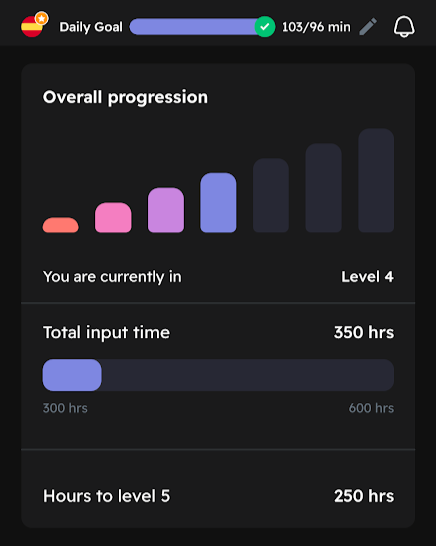
Proof
Snapshot
- Main input: Dreaming Spanish (DS)
- Daily input: ~4h 45m
- Reading: Mostly graded readers (I’ve finished these two and am now working on this one) plus some more difficult material
- Current DS difficulty range: Mostly intermediate content, roughly between 50 and 65, often up to ~75
What’s Improved
One of the biggest changes since 300 hours is that intermediate content increasingly feels like my default environment. Beginner content now makes up maybe 5% of my input whereas around 150 hours it was closer to 40 or 50 percent. I still occasionally enjoy beginner videos because hearing common verbs slowly and clearly can be useful and sometimes the content is just well done, but overall I increasingly find beginner pacing frustratingly slow and insufficiently dense verbally.
A lot of the improvement has not just been understanding more words, but becoming better at quickly recognizing and dialing into the meaning of common verbs like salir, encontrar, pasar, saber, and staying persistent and calm when something is ambiguous or unknown. Earlier on, if I missed a sentence or phrase, especially in fast speech, I would focus too much on the fact that I just missed a bunch of details and lose my hold on the meaning. Now I increasingly notice that when I lose the thread, I don’t panic or lose focus. I can generally recover a few seconds later as my understanding stabilizes again after further discussion.
One thing I’m noticing with street interviews is how much comprehension depends on understanding the framing of the conversation. If I understand the question being asked, the possible range of responses becomes much narrower, which helps me stay attached to the meaning even when people speak quickly or unclearly. More abstract topics like religion are still harder because people go off on tangents and add unexpected details.
I am also noticing that comprehension feels more predictive and contextual than before. For example, two videos with the exact same difficulty rating can feel dramatically different depending on how predictable and limited the topic is, whether the audio is clear, and whether the conversation is abstract or concrete.
A makeup video by Lorena from Argentina at difficulty 73 felt maybe 80 to 85 percent comprehensible because I could anticipate the kinds of words and ideas likely to appear. Another video at the same difficulty about working at a summer camp felt much harder because the story moved unpredictably (for me at least) between events and topics. Plus the sound quality didn’t help.
Street interviews have become much more accessible. They are still difficult, especially depending on the speaker and topic(s), but they no longer feel like impossible noise. I increasingly notice that enunciation matters more than raw speed now. Some people speak quickly but clearly enough that I can follow them fairly well. Others mumble, swallow sounds, have a raspy voice or otherwise fail to enunciate enough for my current level. But overall I notice I’m getting a much larger portion than before.
One especially striking moment recently was realizing I could comfortably sit through an hour of conversation between two Andalusian native speakers with Spanish subtitles and broadly follow the conversation throughout. Around 150 hours, I had tried a similar video from the same channel and could not even finish it because it felt overwhelmingly beyond me even with subtitles.
Subtitles themselves feel different now too. Earlier, subtitles often felt like they were supplying the meaning. Increasingly they feel more like parsing support for fast or reduced speech.
I also intentionally started watching more videos from speakers who historically were hardest for me. These include Ester from the Dominican Republic, Michelle, fast native speakers in street interviews, and Andalusian Spanish speakers. The more I watch Ester, the more of her accent I can understand. Michelle’s cadence and whispery voice quality throw me off, but she has a lot of high quality content, especially her interviews.
These no longer feel completely inaccessible. They still require focus, but I can increasingly stay attached to or recover quickly the broader meaning instead of mentally checking out.
One surprisingly satisfying change is that Andrés has become dramatically easier for me to understand compared to earlier stages. His videos once felt extremely dense and overwhelming, especially at the Beginner level, but now they increasingly feel fast yet trackable. That has been one of the clearest examples of gradual speaker adaptation over time.
Another major change is endurance. I can now fairly comfortably consume three to five hours of Spanish in a day if schedule allows. Spanish increasingly feels enriching instead of mentally exhausting. Honestly, the more Spanish I consume, the hungrier I get for more.
Music has also become more often accessible. I still struggle heavily with lyrics overall, but I increasingly catch phrases and meaning in slower songs. One especially exciting moment was understanding every word of the chorus while listening to Valeria Castro’s cover of El universo sobre mí in real time as it was being sung.
Reading has improved quite a bit too, though not because I suddenly started understanding every word. In fact, one of the most important changes happened after I consciously stopped obsessing over understanding every unknown and allowed myself to stay in the flow of the story instead. I was reminded of this in the intro to an Olly Richards book and it helped reorient me.
Earlier on, especially after finishing one graded reader, I noticed myself getting increasingly perfectionistic and mentally derailed by unknown vocabulary. I would interrupt the flow trying to pin down exact meanings and ironically end up understanding less overall because I became detached from the broader details of the story. It put the brakes on my understanding and enjoyment of the narrative by excessively slowing me down.
Once I consciously relaxed that impulse, reading became much more enjoyable and sustainable. I increasingly trust that context will often clarify meaning, repeated exposure matters more than immediate mastery and understanding the overall idea is more important than perfect lexical precision.
One advantage reading has over listening is that I can pause, reread, and inspect a sentence more carefully without the pressure of disappearing audio. Often I can infer the meaning of a word or phrase just from context and surrounding sentences. And when I cannot, I increasingly find that it is okay to simply move on and let the language continue unfolding.
That shift toward trusting flow over perfection has probably been one of the healthiest changes in my process recently. It has positive ramifications for my listening, too; it has given me more confidence that if I just focus and keep listening I will generally figure out what’s being discussed.
What’s Still Hard
There is still an enormous amount that I do not understand and that hasn’t yet solidified.
Fast native speech without subtitles can still be extremely difficult, especially with overlapping speech, strong regional accents I’m not accustomed to, people speaking while laughing or at the same time, and unclear enunciation.
Andalusian Spanish in particular remains very beautiful but very challenging for me, especially because of swallowed final s sounds and compressed speech. I love how it sounds but it comes at an infamously breakneck speed. I watched a video about La Feria de Abril en Sevilla where subtitles helped tremendously. Without them I would have struggled significantly more, probably going from ~90% down to 60% comprehension.
Street interviews remain uneven too. Sometimes I can follow large portions of them, other times a particular speaker is almost impossible for me to understand clearly.
Abstract content is still harder than concrete content. Conversations about philosophy, religion, self-help, or introspection often feel much more difficult than travel, food, family dynamics, or daily routines because the vocabulary is more specialized and the range of topics expands significantly so it’s much harder to predict.
I got a self-help book in Spanish based on a recommendation by Sophia in this joint video with Michelle and Sophia1. Sophia said the book was good for learners, but it’s far more difficult than the couple of graded readers I’ve read so far. I’m going to take my time with it and come back to it later. It reminds me that I still have a long way to go with Spanish even though progress is evident.
I also still regularly have the feeling that I do not know enough words. Sometimes I know I have encountered a word before, maybe for something ordinary like basil, apricot, zipper, or hanger, but when I try to consciously retrieve it, it simply is not there yet.
Speaking is also still awkward and limited. I increasingly notice that after trying to speak Spanish, I become overly focused on output and start trying to formulate Spanish in my head while listening to videos. I have to consciously remind myself to relax and return to listening mode instead of turning every input session into a game of “how would I respond or say that in Spanish?”
I also realized that I tend to overpredict in conversation even in English. Spanish has made me much more aware of how easy it is to stop truly listening and instead start mentally preparing responses or projecting where the conversation is going. I increasingly have to remind myself to relax and let meaning unfold instead of forcing immediate certainty.
One thing I am increasingly noticing is that transitions between topics are often harder for me than the topics themselves.
If a speaker stays within a relatively constrained subject area, like makeup, travel, family dynamics, food, or a game show format, I can increasingly anticipate the kinds of vocabulary and ideas likely to appear. Even when I miss words, the surrounding context for a smaller, more focused topic helps me stay attached to the meaning.
What still trips me up more often is when conversations suddenly pivot to a new topic, shift into a personal story, move into abstraction, or unexpectedly change direction. Those transition moments can temporarily break my internal sense of where the conversation is heading and make me lose the thread for a few seconds while I recalibrate.
I especially notice this in podcasts, street interviews, and conversations with several speakers where people naturally jump between ideas more unpredictably. At the same time, I think I am improving at recovering after those moments instead of mentally collapsing or giving up on comprehension entirely, although it’s not perfect.
What I’m Doing Now
Most of my input is still Dreaming Spanish, though I am increasingly mixing in podcasts, graded readers, learner YouTube channels, native YouTube content, music, and street interviews.
I have especially been enjoying:
- Español con Juan. I didn’t realize until after I watched a few of his videos that he’s the author of the graded reader I’m currently reading. Really enjoying his written and video content lately which I highly recommend for intermediate learners. He speaks at a very comfortable pace and with a lot of humor about the language learning process and life in general.
- Agustina and Andrea podcasts. They’re an excellent combo together and I’ve been getting a lot of mileage out of the DS podcast episodes generally.
- Pasapalabra. This is a new series on DS and it’s apparently adapted from an actual Spanish game show
- My Daily Spanish. Not everything on here works as CI and Spanish subtitles can’t be disabled, but there’s a lot of high quality content about Spain
- Dreaming Spanish In Person episodes where the team gets together in a series to discuss various topics. In addition to the speed, people talk over each other and the group conversation sometimes splinters into several smaller ones, but it’s very entertaining and a nice challenge
- Street interviews from Mexico and Spain
One of my favorite discoveries recently has been Pasapalabra on Dreaming Spanish. The game show format naturally creates huge amounts of paraphrasing, synonym use, commands, reactions, and vocabulary recall while still being genuinely fun to watch. Experiences like that increasingly make Spanish feel less like study and more like participation. It would be great if they also did something like this in the format of The Floor.
One thing I increasingly appreciate about strong comprehensible input is how good speakers naturally use synonyms and restate what was just said with slightly new phrasing.
Agustina in particular is extremely skilled at restating ideas from multiple angles, and I increasingly notice how much that helps meaning lock in more naturally and build more connections between words.
Several weeks ago I switched my phone into Spanish after hearing Pablo recommend increasing ambient immersion. For the first month it felt surprisingly overwhelming at times, but because I already knew my phone layout well, I was able to persist without switching back. One unexpectedly exciting moment was realizing I could comfortably follow Spanish GPS directions during a recent trip to California.
I also briefly tried switching my laptop into Spanish around the same time, but quickly switched it back to English. That experiment taught me something useful: immersion only works when the friction remains manageable. My phone created lots of small repeated exposure moments throughout the day without significantly slowing me down, whereas my laptop became more cognitively draining than helpful.
Reading has become more consistent too. I am mostly reading graded readers, but I have also started experimenting with more difficult material outside my comfort zone.
Notable Moments
One of the coolest experiences recently happened unexpectedly while listening to an Argentine live music performance by La Valenti. Between songs, she spoke casually to the audience and told a story before one of the songs. I realized I could follow much of the banter and understood a surprising amount of what she was saying. It suddenly hit me that I could realistically attend a concert in Argentina and meaningfully experience parts of it in Spanish.
Another major moment happened while speaking with a Venezuelan repairman and his son, who was seven, when they came to fix our refrigerator. We ended up talking off and on in Spanish for maybe 30 minutes about Minecraft, horror movies, Mortal Kombat, school, Venezuela, Texas, music, and learning English and Spanish.
I absolutely lost the thread sometimes, especially with the child speaking quickly and naturally, but the conversation kept going. None of it was rehearsed or memorized. It was messy and imperfect but undeniably real.
One small but fascinating moment during that interaction was when the verb arreglar suddenly surfaced naturally in my mind while talking about fixing something. I was not consciously translating or searching through grammar rules. The word simply appeared because the situation called for it. Moments like that make the acquisition process feel visible.
At another moment during that same interaction, the repairman asked me what tornillo and destornillador was in English, and after I answered “screw” and “screwdriver,” he pointed out the “driver” part of the word as in driving a car. I had never really consciously noticed the weirdness and poetry of that compound word before.
I also increasingly notice that Spanish is leaking into daily life. I occasionally very often drive my family crazy by using small phrases or commands (probably with lots of errors) around the house.
-
Although the book’s entitled Dios Nunca Parpadea, Sophia claimed it wasn’t religious. I’ve read three chapters so far and it has mentioned god in every one. It’s not especially preachy and the lessons are generally applicable in a secular context but the text is firmly rooted in religious belief. ↩︎
Comments